How to Read a Matcha Tin: Label, Batch, Eco Label and Certificate of Analysis
How to read a matcha tin: mandatory information, Japanese terms, batch and best-before date, the EU eco logo and what a certificate of analysis says.
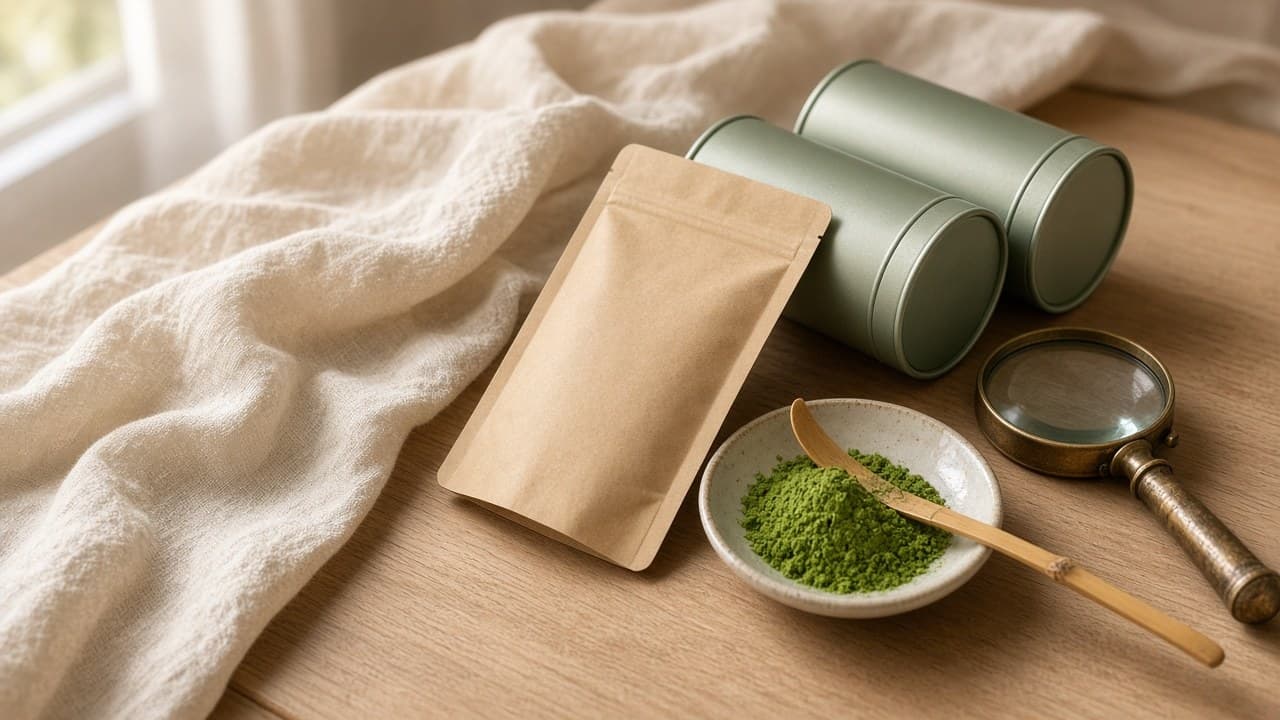
A matcha tin carries more information than you see at first glance: name of the food, ingredients, net quantity, producer, best-before date and usually a lot number. The batch tells you which production lot is in your tin, a certificate of analysis can document measured values for exactly one such lot, and for ecologically produced goods the code of the control body always belongs on the label. This article explains in general terms how to read all of this, and what each item says and what it does not.
Mandatory information on food: what is shown before and after purchase
In the EU, the Food Information Regulation (LMIV in Germany) applies to prepackaged food. An online shop must show most of the mandatory information before the purchase, not only on the pack. This includes:
- Name of the food
- Ingredients list and allergens
- Net quantity
- Storage and usage instructions
- Name and address of the responsible food business operator
- Origin, where it is required
- Unit price (price per kilogram)
The best-before date is exempt from the online obligation and appears on the pack. The same applies to the lot number. If a shop is missing any of the other items before purchase, that is a reason to ask. In addition, a shop needs a legal notice (Impressum) with name, address and a quick way to make contact, and companies must also provide commercial register details and a VAT ID, where applicable. How you can withdraw as a consumer in distance selling is set out in the shop's own withdrawal policy.
Ingredients list: what is in pure matcha
Pure matcha contains only ground green tea. A separate ingredients list may be omitted if the name of the food clearly shows the single ingredient. If an ingredients list is present, it names green tea or matcha. If it says more, such as sugar, milk powder, flavouring or plant extracts, it is not pure matcha but a blend, for example a latte powder. That is not automatically bad, but it is a different product and should be named as such.
Also pay attention to the order: ingredients are listed in descending order by weight. If sugar comes first, most of the blend is not tea.
Japanese characters and terms on the tin
Many tins from Japan carry only Japanese script or a small sticker with a translation. A few terms appear on almost every tin:
- 抹茶 (Matcha): fine powder made from shaded, steamed and ground tea leaves.
- 原材料名 (ingredients): the ingredients list follows this field.
- 内容量 (contents): the net quantity, usually in grams.
- 賞味期限 (best before): the date until which the producer promises the expected quality. The order of year, month and day differs from pack to pack.
- 保存方法 (storage): storage instructions, for matcha usually cool, dark and tightly closed.
- 製造者 (producer): who makes or packs the product.
- 宇治 (Uji): a well-known tea-growing area. The place name on a tin is an origin statement by the producer, not a quality verdict.
A translation app often reads characters on glossy, curved tins poorly. Photograph the label flat, in daylight and without reflections, and it works better.
Additional terms: "Ceremonial", grind and harvest
"Ceremonial" is not a protected term. Any producer may use the word, and without further details it says nothing verifiable about the product. Ask instead about origin, harvest year and batch.
Some tins also name the type of mill or the time of harvest. A note on the mill describes how the powder was ground, and a note on the earliest spring harvest means the leaves come from the first shoots of the year. Both are producer statements. Have the retailer back up such statements before you accept them as a reason to buy.
The "Nihoncha" mark (日本茶)
Since 10.07.2026, "Nihoncha" (日本茶, Japanese tea) has been registered in Japan as a geographical indication (GI). According to the Japanese agriculture ministry (MAFF), it is the first geographical indication that covers not a single growing area but Japanese tea as a whole: green tea grown and processed in Japan, matcha included. Only products that match the registration may carry the name as a geographical indication and the GI mark. As one reason the ministry names cases such as "Uji matcha" made in China being sold [1].
What the mark says: the tea was produced and processed in Japan and meets the criteria of the registration. What it does not say: it says nothing about residues, measured values or the taste of a particular tin. For that, the batch, the certificate of analysis and your own tasting count.
Batch, harvest and best-before date
A batch (also lot) is a production lot that was made or packed under the same conditions. The lot number is the identifier of that lot. It helps the producer to trace exactly which goods are affected in the event of queries or recalls.
- Where is it? Usually on the bottom of the tin, on the back or on the lid. It is often printed or embossed and begins with "L", "LOT", "Lot no." or "Ch.".
- Where is the best-before date? Often right next to it, sometimes also as a sticker applied by the retailer or packer.
- No lot number? In the EU, a sufficiently precise best-before date can replace the lot marking. A tin with no information at all is a reason to ask the retailer.
- Harvest and vintage: A harvest year appears only on some tins. It is not the same as the best-before date and not the same as the lot number.
The best-before date is not an expiry date. It says until when the producer promises the typical properties if stored correctly. After opening, air, light and heat change the powder, so you should ideally use up an opened tin within a few weeks. If matcha smells musty or rancid, is damp, forms damp clumps or you see mould, throw it away. Colour or taste alone say nothing about whether a powder can still be used.
EU eco logo and control body number
Only goods that were produced and inspected under the EU rules on ecological production may carry the EU eco logo (the green leaf made of stars). Two details matter when assessing it:
- the control body number: it consists of a country code, a word for ecological and a number, and names the body that inspects the business; it must be given on goods labelled as ecological
- the origin statement for the agricultural raw materials, that is, whether they come from the EU, from non-EU countries or from both; it belongs with the label when the EU eco logo is used
A missing control body number is a warning sign. A picture of a green leaf or words such as "natural" or "all-natural" do not replace the logo. On Japanese tins, ecological goods often show 有機 (yūki) and a JAS mark. Imported goods may be sold as ecological if they meet the relevant EU import rules. The control body code must be given; the EU eco logo is optional for imported products. If the logo is used, the statement on the origin of the agricultural raw materials belongs with it too. The responsible authorities publish details on this.
What the label does not say: it describes the type of cultivation, not the taste. Whether an eco matcha tastes "more natural" cannot be answered with it, because variety, shading, harvest time and processing shape the taste far more. The label is also not a statement about individual measured values. If you want to know what was measured in a particular batch, look at the certificate of analysis. "Shaded" (or "shade grown") is not an indication of ecological production either: shading describes a step in growing Tencha, from which matcha is ground, and has nothing to do with the eco logo. And "low in acid" is not a regulated statement on matcha tins: if a retailer writes something like that, ask what it is based on.
Whether you buy goods with or without the eco logo, you decide by the criterion that matters to you: type of cultivation, price, taste or verifiable measured values. You can find information about each in a different place.
Certificate of analysis (COA): what it says and what it does not
A certificate of analysis (COA for short) is a document in which a testing laboratory records the results of measurements on a particular sample. It is a measurement report. It says what was measured on this sample and with which method, and no more.
How to recognise a usable certificate
- Name of the laboratory and date of the report
- Sample description with product name and lot number (batch number)
- Sampling: date and who took the sample
- Parameters: what was measured
- Method: by which procedure it was measured
- Measured value with unit and limit of quantification: the lowest content the method can quantify with sufficient accuracy. A limit of detection, if also given, is the lowest content at which the substance can be detected.
- Reference value, if available, for example a legal maximum level
- Signature or release by the laboratory
How do you match batch and certificate?
The lot number on the tin must match the lot number in the certificate. If the certificate shows only a product name and a date, you cannot assign the document to a particular tin. A certificate for a different batch says nothing about yours. The same applies to certificates that apply jointly to several products or varieties: check whether your product and your batch are actually meant. Also: a sample stands for a lot, but is not the whole lot.
Which values appear?
For matcha and other tea, these groups are often named:
- Pesticide residues: often per substance or as a sum, with limit of detection and limit of quantification
- Heavy metals: usually lead, cadmium, mercury and arsenic
- Aluminium
- Microbiological values: for example germ counts, yeasts and moulds
- Radioactivity: for tea from Japan often caesium
Not every certificate covers all groups. What was not measured is not in there, and a missing value is not a statement. For pesticide residues there are legal maximum levels, whose current version you can find with the authorities. This article does not evaluate figures and says nothing about whether a value suits you. It only explains where to find them and how to put them in context.
Reference values: what authorities have set
Status: 05.10.2026. For some of the substances listed there are values that authorities use for orientation. They help to put figures in context and are not an assessment of any single certificate:
- Aluminium: There is no EU maximum level for aluminium in tea. In 2008 EFSA derived a tolerable weekly intake of 1 mg aluminium per kg body weight, as the German Federal Institute for Risk Assessment (BfR) sets out in 2019 [2]. In 2025 the French agency ANSES set a reference value for long-term intake of 0.036 mg per kg body weight per day [3]. Both values refer to intake from all sources together, not to the content of a single food. They therefore cannot be compared directly with a measured value in mg per kg of powder.
- Perchlorate: For tea, an EU maximum level of 0.75 mg per kg applies, based on the dried product [4].
- Anthraquinone: For dried tea leaves, an EU maximum residue level of 0.02 mg per kg applies [5].
For the order of magnitude: the Chemical and Veterinary Investigation Office (CVUA) Stuttgart measured aluminium contents of 512 to 2,085 mg per kg in matcha samples it reported on in January 2026 [4]. This shows the range in which such measured values can lie for matcha. It says nothing about a particular tin.
Warning notices, "Cleanest Matcha" and measured values
Some tins carry notices about lead or other substances. Such notices often go back to labelling rules of the country of sale and say nothing in themselves about the measured values of your specific batch. That also applies to questions like "Is there lead in eco matcha?": the label regulates cultivation, the measured values are in the certificate of the batch. Terms such as "clean" or "pure" are not defined labelling terms. Ask instead what was measured, for which batch, with which limit of detection and limit of quantification and by which laboratory.
Identifying an unknown tin
You were given a tin or bought one on a trip and want to know what is inside or where to find more of it? Here is how:
- Photograph everything: front, back, bottom, lid and seal, each flat and in daylight.
- Translate fields: take the terms from the section above and look first for producer (製造者), contents (内容量) and ingredients (原材料名).
- Find the producer or packer: name and place of the producer are usually printed small at the edge. With these details you find the producer's website.
- Compare the product name: compare tin shape, characters, net quantity and name with the products on the producer's page, not just with pictures from resellers.
- Clarify where to buy: for reordering, the producer itself, specialist tea shops or online shops that expressly confirm delivery to your country are suitable. Watch for shipping costs, import duties and delivery time.
- Ask: send the producer or retailer the photos with the lot number and ask which product it is.
If you find nothing, that is no proof of a bad product: some tins are regional products that were never exported.
When to ask the retailer
Ask if any of the following information is missing or unclear:
- Origin (country and region) and harvest year
- Lot number and best-before date on the pack
- Ingredients list, net quantity, unit price, name and address of the operator
- Evidence for statements such as mill, harvest time or eco label (control body number)
- For every measured value mentioned: batch, laboratory and report date
Reputable retailers answer such questions concretely. The following also applies to authenticity: you rarely recognise a counterfeit tin from a photo. Compare spelling, label and price with the producer's own page and buy only from retailers whose legal notice (Impressum) is complete. For more on how to recognise quality and what matters when choosing, see the selection guide.
Frequently asked questions
Can eco matcha contain lead?
Yes, ecologically produced matcha can also contain traces of lead. The eco label describes cultivation and inspection and does not rule out lead. For contaminants such as lead, EU maximum levels apply, set per substance and food group, regardless of the type of cultivation. Measured values of a tested sample can be shown by a certificate of analysis assigned to that batch.
Does eco matcha taste more natural?
The eco logo describes the type of cultivation and inspection, not the taste. Variety, shading, harvest time and processing shape the taste far more. You can only find out whether you like a matcha by trying it.
Does shading mean ecological production?
No. Shading is a step in growing Tencha, from which matcha is ground, and takes place in ecological as well as conventional production. Whether goods were ecologically produced is shown by the control body number and, where applicable, the EU eco logo.
How do I choose eco matcha if taste and quality matter?
First check the control body number so that the ecological production is documented. For taste and quality, the other details then help: origin, harvest year, lot number, best-before date and the planned preparation. If any of them is missing, ask the retailer.
Does ecological production say anything about quality?
It says something about cultivation and inspection, but nothing about taste, freshness or individual measured values. Those points depend on variety, processing, storage and the particular batch. Measured values for a batch can be shown by a certificate of analysis.
Sources
- Ministry of Agriculture, Forestry and Fisheries (MAFF) (2026): 茶をめぐる情勢 (Japanese). Tea situation report, July 2026, section 20.
- Bundesinstitut für Risikobewertung (BfR) (2019): Hohe Aluminiumgehalte in einzelnen Matcha-Teeproben. BfR, Opinion No. 27/2019, 25.07.2019.
- Agence nationale de sécurité sanitaire de l'alimentation, de l'environnement et du travail (ANSES) (n.d.): List of ANSES toxicity reference values (TRVs). ANSES. Aluminium entry: 2025. Accessed 5 October 2026.
- Schumacher I, Löw C, Benkenstein A (2026): Matcha: Grüner Genuss pur oder auch versteckte Risiken? Rückstandssituation und Aluminiumgehalte. CVUA Stuttgart, Untersuchungsämter Baden-Württemberg, 16.01.2026.
- Li CWY, Walters S, Müller JF, Orlando J, Brasseur GP (2023): Contamination of tea leaves by anthraquinone: The atmosphere as a possible source. Ambio 52(8):1373-1388.
Related products
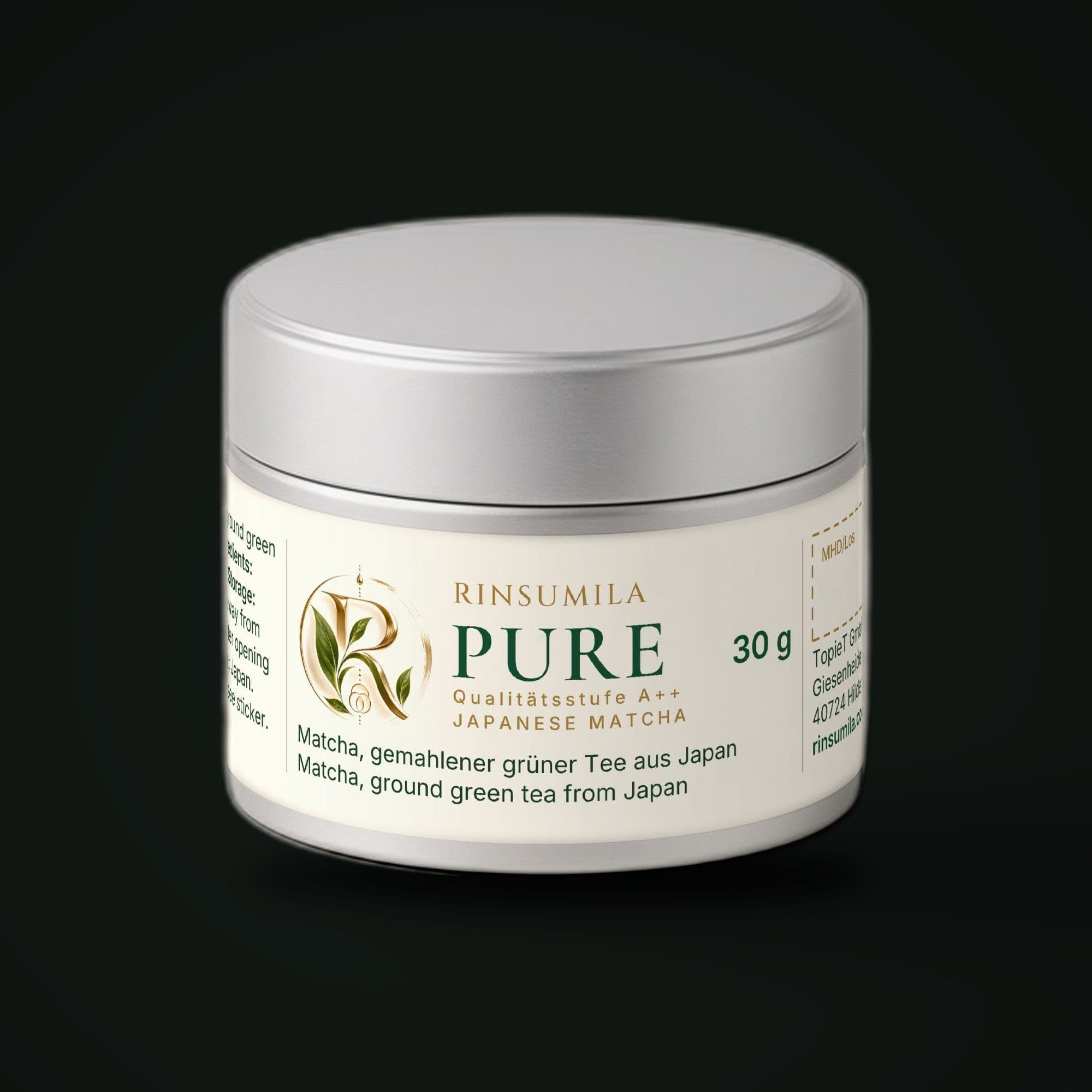
RINSUMILA PURE
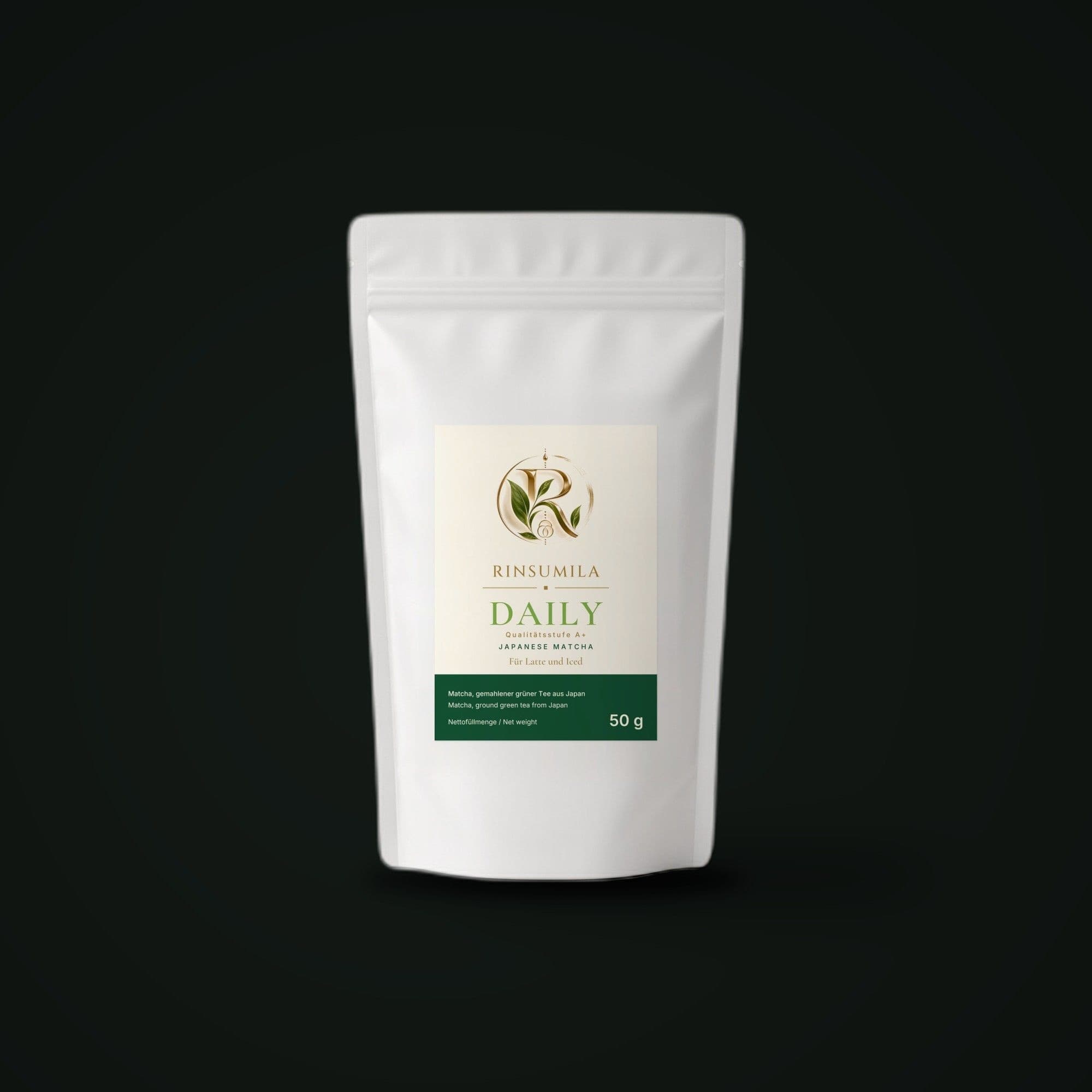
RINSUMILA DAILY
More guides