Ceremonial, Premium, Culinary: What the Terms on the Tin Mean
Ceremonial, premium, culinary: what is behind the terms, why there is no standard and which details on the tin say more than the word.
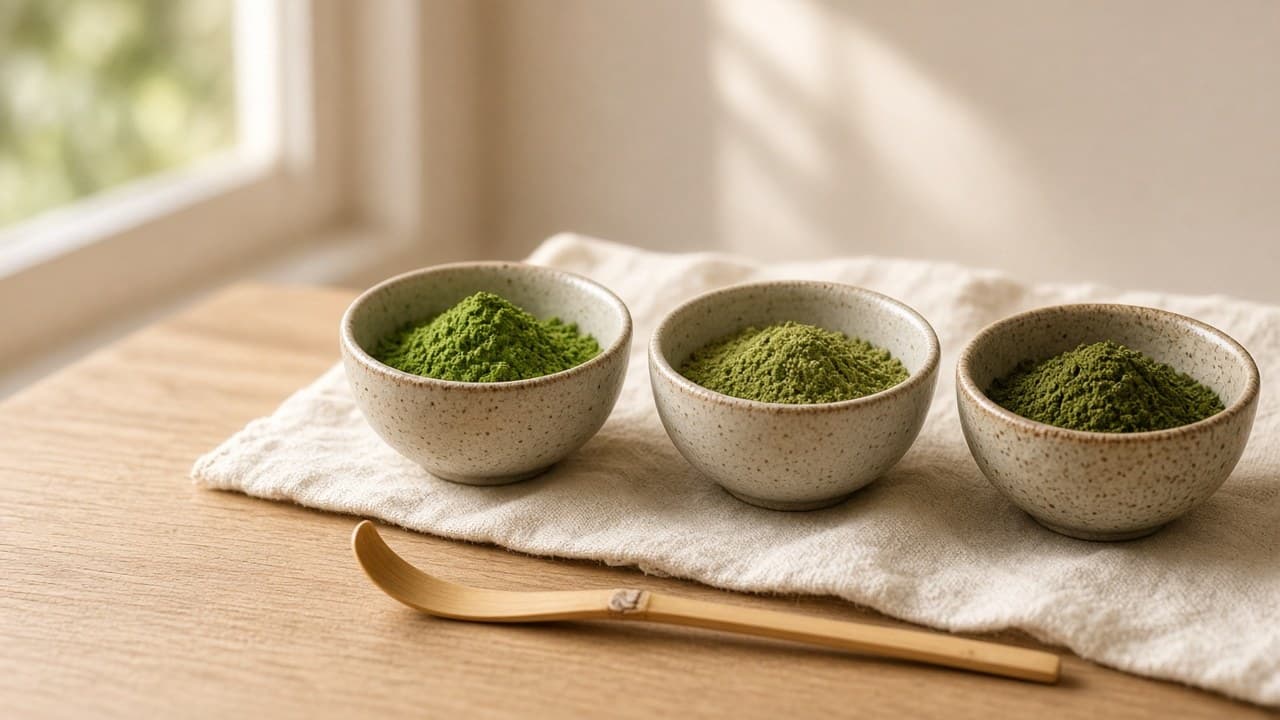
Ceremonial, premium, culinary and similar words on matcha tins are trade terms used by manufacturers, not protected designations. There is no standard that determines which powder may carry which name, so two tins from different suppliers cannot be compared through these words. More meaningful are origin, intended use, ingredient list, freshness and price per gram. This article explains where the terms come from, what they usually mean and how to compare two tins instead.
The terms and where they come from
In Japan itself the English words traditionally play no role. Tea houses there sell matcha under their own names for their blends and tend to distinguish by use: whisked thin (Usucha) or stirred thick (Koicha), for the way of tea or for sweets and drinks. The division into ceremonial and culinary is a pair of terms from export and marketing language, mainly for the English-speaking market. What a manufacturer means by each word is only found in its own product description.
What the terms usually mean:
- Ceremonial is not a protected designation. Which powder carries the word is decided by each manufacturer itself.
- Premium, superior, imperial, gold or select are intermediate or additional tiers that every supplier defines for itself. Two manufacturers can mean completely different powders with the same word.
- Culinary (sometimes also cooking, latte or kitchen grade) is what suppliers mostly put on powder they intend for latte, baking, ice cream or smoothies. The label alone reveals neither taste nor harvest time. For that, check the manufacturer's specific product description.
None of these terms tells you which region the leaves come from, when they were harvested or how fresh the powder is. At most they describe what the manufacturer itself intends its powder for.
No uniform standard: what that means for buyers
There is no official standard, neither in Japan nor in the EU, that determines when a matcha may carry the term ceremonial. Ceremonial is not a protected designation, and the same goes for culinary, premium and all the other grade labels. Every manufacturer builds its own ladder: at one supplier even the entry-level powder carries the term ceremonial, at another the middle tier is called that, and a third only awards the term to its most expensive blend.
For you as a buyer this means:
- The words are useful for comparing within one range, not between manufacturers. If a supplier has three tiers, the order says something about its own assessment, not about the market.
- A high price or a nice-sounding word is no guarantee that you will like the powder. Conversely, a powder labelled culinary can be exactly what you are looking for in your latte.
- If an expensive powder still tastes bitter, it is often down to water that is too hot, too much powder or an old pack, not the word on the tin.
- The confusion is normal. If you are standing in front of the shelf and do not know what separates premium from ceremonial, you have not missed anything: the terms are not made to be compared.
Is the grade label then a lie? Not automatically, more a rough sorting aid from the manufacturer. The label alone does not prove a quality level. So check the concrete details about the powder.
The caffeine content cannot be read from the grade label either. Matcha contains caffeine, regardless of which word is on the tin. Only the manufacturer can tell you exactly how much caffeine its powder contains.
What laboratories have measured for the terms
Status of the literature: October 2026. Several studies have analysed commercial samples sold under the term ceremonial or culinary. The results describe the composition of these samples:
- Samples sold under the term ceremonial contained more chlorophyll and caffeine, samples sold under the term culinary more phenolics (ten matcha samples, 2025) [1].
- Cheaper samples sold under the term culinary had more phenolics than samples sold under the term ceremonial (commercial green teas, 2023) [2].
- In a study of three quality grades, amino acids and caffeine decreased from the highest grade down to the food grade, while polyphenols increased (2025) [3].
These differences only describe the composition of the samples studied, not a ranking. The grades can indeed be measured: in one study, a method combining spectral imaging and machine learning assigned almost all samples to the correct grade (2024) [4]. Even so, there is no standard for which measured values belong to which term. Ceremonial is not a protected designation, and nothing can be read from these results for a single tin, because every manufacturer awards the terms differently.
What to look at instead: origin, harvest, colour, price, details
More meaningful than any grade label are details that can be checked:
- Origin. Country of cultivation and, if possible, region. "From Japan" alone is a rough statement; a region on the pack is more precise. Matcha from other countries is not automatically worse, but you should know where it comes from.
- Harvest time and harvest year. Some manufacturers state the year or season of the harvest. Leaves from spring are considered more tender than leaves from later harvests. This is a manufacturer's statement: helpful if it is backed up, otherwise just another word.
- Colour and smell. Fresh, fine powder is evenly green and smells grassy-sweet. Yellowish or brownish tones point to age, poor storage or different raw material; colour alone proves nothing, though, and a photo online certainly does not. Discard matcha that smells musty, is damp, has damp clumps or shows visible mould.
- Ingredient list. Pure matcha contains only ground green tea. If sugar, milk powder or flavouring is listed, it is a mix, no matter which grade label is on the front of the tin.
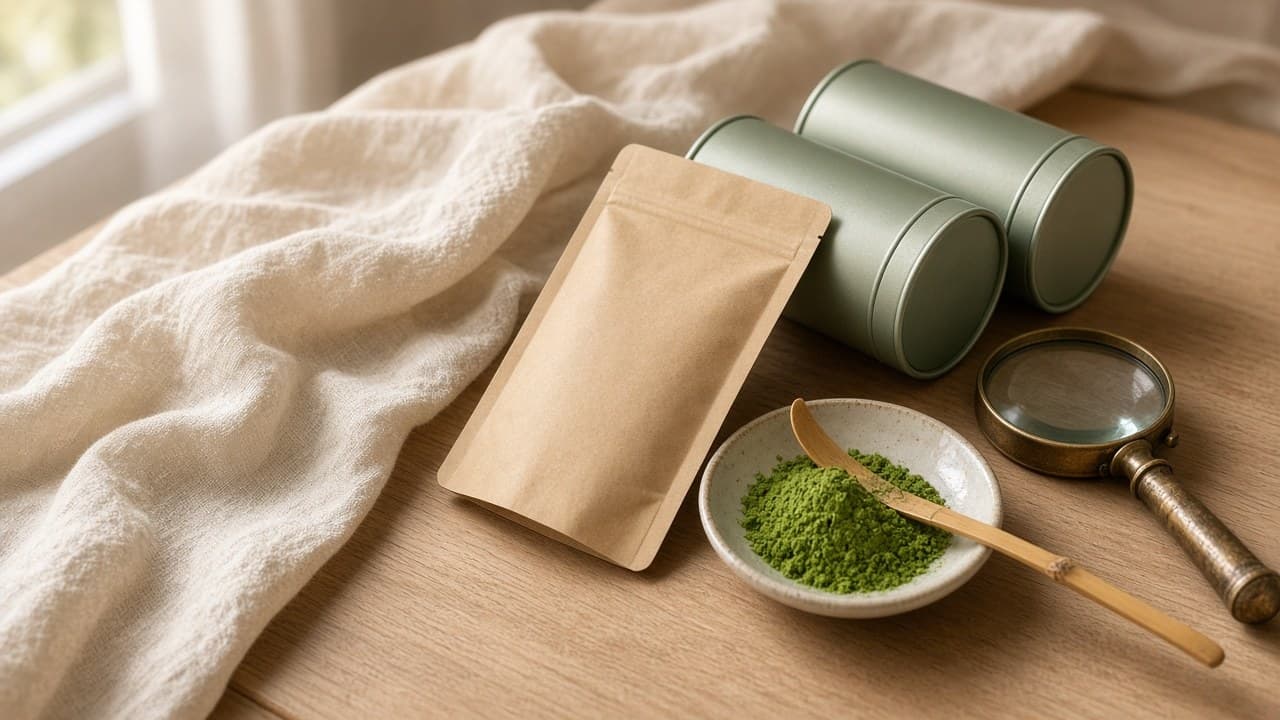
- Best-before date and lot. The best-before date is on the pack. The lot or batch marking is also there; a sufficiently precise best-before date can replace it. The marking serves to identify the product's production lot.
- Price per gram. Convert every price to the same amount. As a guide: 30 g of Japanese matcha costs about €19 to €49 in shops. If an offer is far below that, ask what is in the powder; if it is far above, the manufacturer should be able to explain why.
- Intended use. If the manufacturer says what it intends the powder for (plain, latte, baking), that is more useful than any grade label, because it is a concrete recommendation.
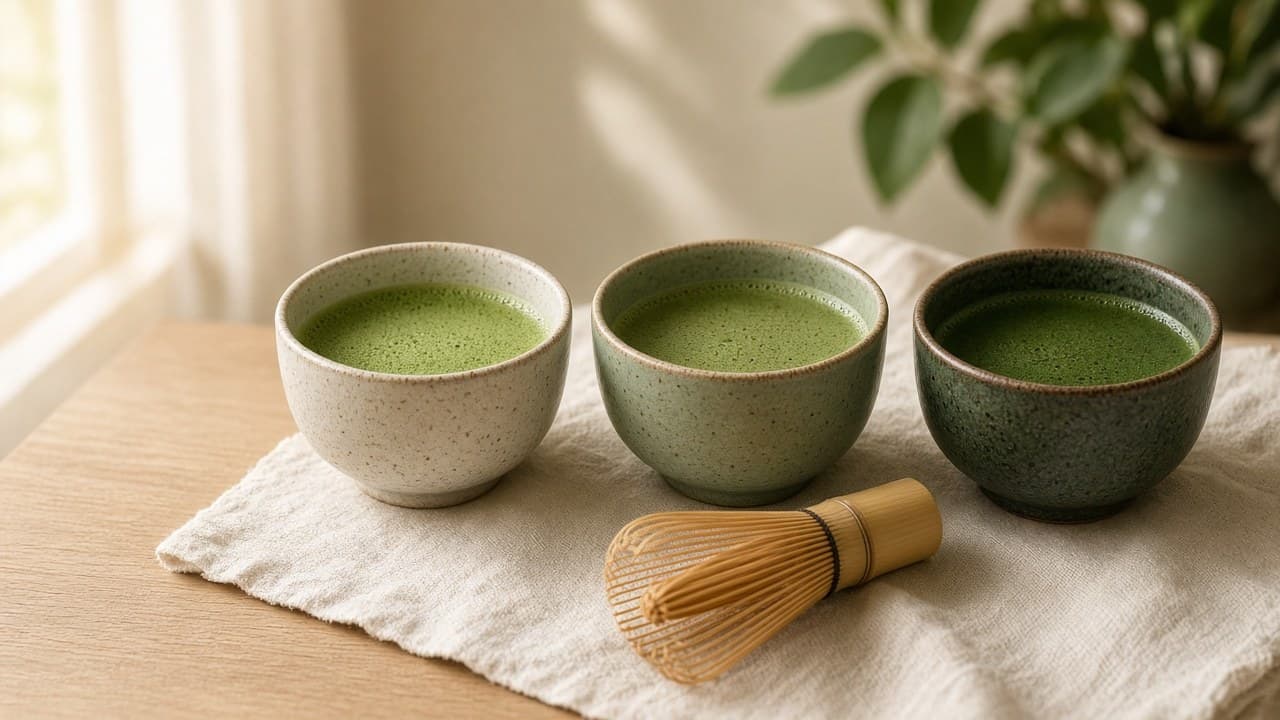
How do you compare two tins in practice? Put them side by side and go through the list: origin, harvest year, ingredients, best-before date, price per gram, intended use. Then prepare both the same way: 2 g each, sieved, 70 ml of water at about 75 °C, whisk for 15 to 30 seconds. Smell, look at colour and foam, taste. The comparison in the mouth says more than the comparison of the labels. A blind test with two people helps, because otherwise knowing the price can influence your judgement. If after this test you find no difference that is worth the extra price to you, you can choose the cheaper one.
Latte matcha versus plain matcha
More sensible than grade labels is the distinction by preparation. Whisked plain with water, you drink the matcha without milk: every nuance, including all the astringency, comes through. A mild, fine powder suits that. In a latte the matcha meets 200 ml of milk or oat drink. Milk covers fine notes and softens astringency; a stronger, grassier powder holds up better here, and fine differences between two powders show less clearly in a latte than plain.
Is a powder with the term ceremonial suitable for latte? Yes, you can use any powder for latte. Whether an expensive powder is worth it there is a matter of taste and money that only your own comparison answers. Conversely, may you only use culinary for latte? No, there is no such rule. Culinary is only a hint from the manufacturer about the intended purpose. Without a reliable survey, it cannot be stated how many people drink matcha with this label. For your choice that is irrelevant anyway: you may drink any powder the way it tastes good to you.
Is culinary matcha worse, or simply intended for a different use? The term says neither: it is a hint from the manufacturer about the intended purpose, not a statement about quality. A powder with any grade label can become old or flat; discard matcha that smells musty, is damp, has damp clumps or shows visible mould, and colour or taste alone say nothing about whether it is usable. If you use a powder meant for matcha served straight in a bowl in a latte, you are not drinking anything wrong, but you often pay for nuances that the milk covers. If, conversely, you drink a strong powder plain, you may find it too astringent. That says nothing about quality, but about fit.
How we describe our products (without grade promises)
We do without grade labels and describe our varieties by what can be checked: intended use, taste, origin, net weight, price.
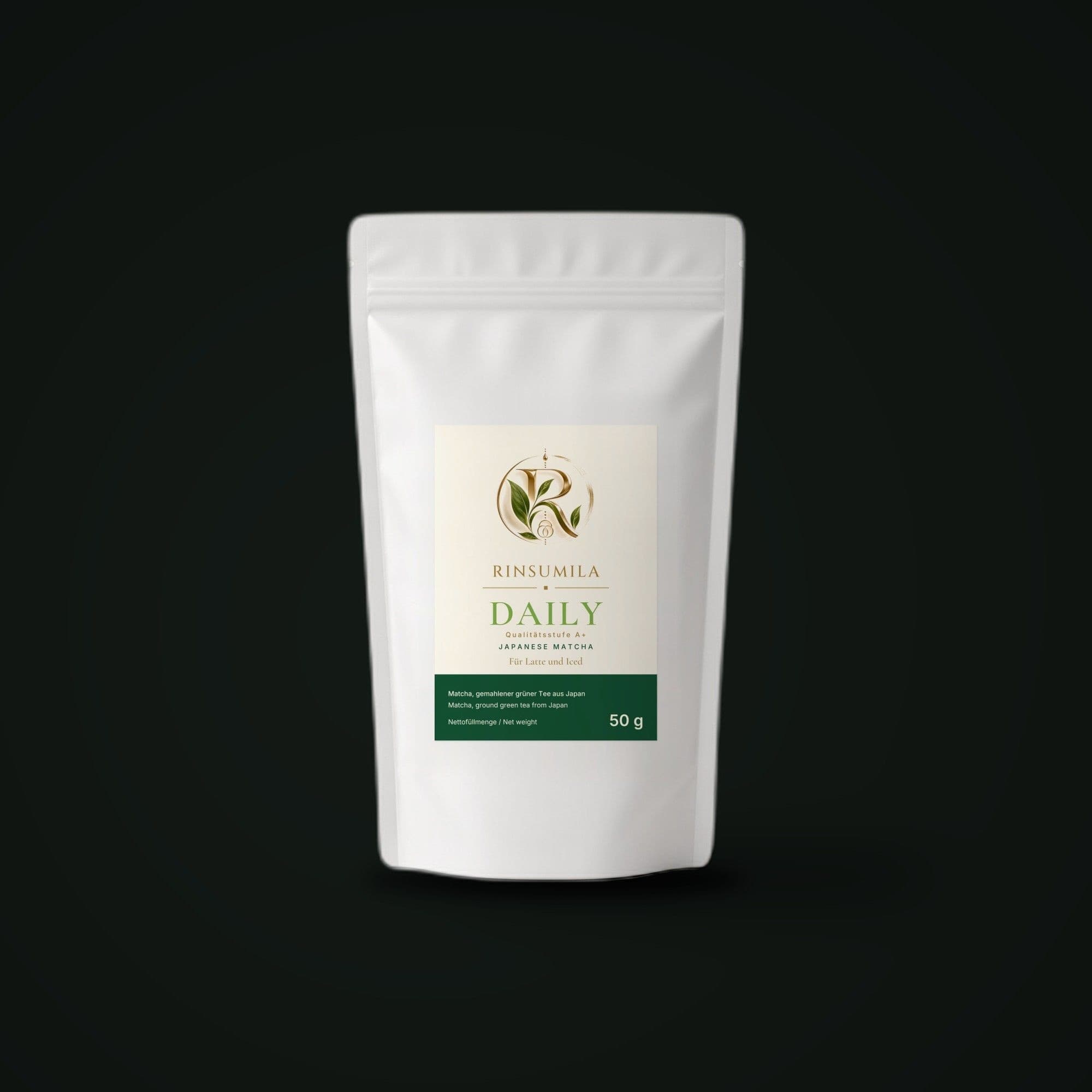
- RINSUMILA DAILY is our matcha for every day: ground green tea from Japan, fine and without bitterness in taste, made for latte and iced latte, also possible plain with water. It comes in the 50 g doypack for €34.90 (€698.00/kg); at 2 g per glass one pack lasts for about 25 glasses.
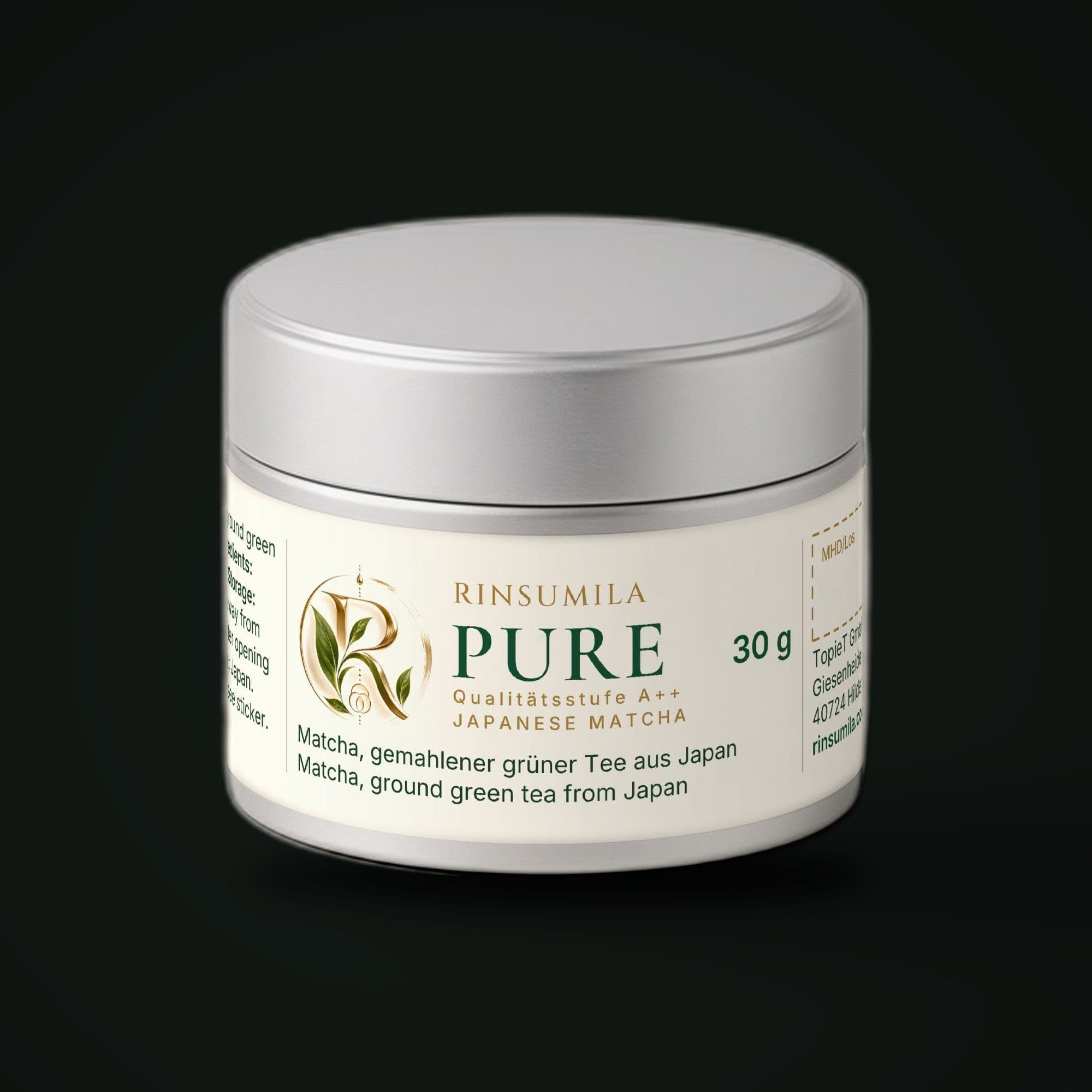
- RINSUMILA PURE is meant for the bowl: whisked plain with water, slightly sweet and without bitterness in taste. It comes in the 30 g tin for €39.90 (€1,330.00/kg), which at 2 g per bowl makes about 15 bowls.
Best-before date and lot number are on a sticker on both, and via the QR code on the pack you look up your batch. Whether DAILY or PURE suits you is decided by your preparation, not by a word on the tin. More on choosing is in the selection guide; the product page of RINSUMILA PURE shows all details of the variety for the bowl.
Checklist before buying
Before you put a tin in the basket:
- What do I need the powder for: plain, latte or baking? I choose by that, not by the grade label.
- Is a country of cultivation on the pack, ideally with region?
- Does the ingredient list contain only ground green tea?
- Are best-before date and lot or batch marking given, where applicable with a sufficiently precise best-before date as a substitute?
- What is the price per gram, converted to the same amount?
- Does the manufacturer state the harvest year or harvest time, and can it back that up?
- Is there a legal notice (Impressum) with name, address and contact?
- Besides the grade label, is there a concrete description of taste and preparation?
If you only find the grade label and nothing else, that is the moment to ask the seller or keep looking. This applies to every brand, including ones someone has recommended to you; we do not rate other brands, but you can apply the list to any of them. It also helps with two tins from the same supplier: if the two differ only in the word and the price, but not in origin, harvest or ingredients, only the manufacturer can explain what you are paying more for. And if sugar or milk powder is in the ingredient list of one of the two products, you are not comparing two matchas at all, but a matcha with a drink powder.
Frequently asked questions
May I only use culinary for latte?
No. There is no rule that prescribes a particular powder for you. Culinary is a hint from the manufacturer about the intended purpose, nothing more. You can use any powder for latte; whether a mild, expensive powder is worth it there, you find out through your own taste comparison.
What does imperial grade mean?
Imperial, like premium, superior or gold, is a freely chosen grade label without a fixed definition. The manufacturer's description tells you where the powder sits within its range. Check the same details as with any other tin.
Culinary or ceremonial: which term should I choose by?
By neither, but by your preparation. For latte, iced latte and baking a stronger powder is suitable, for matcha served straight in a bowl a mild, fine one. Read the manufacturer's description of intended use and taste; it is more meaningful than the word.
Is culinary matcha worth it?
That depends on the specific powder, not on the word. For latte, baking, ice cream and smoothies a powder with this label can be suitable; how it tastes plain is only shown by a trial sip. Here too, look at origin, freshness and ingredient list, because a grade label protects neither against old powder nor against a mix with sugar.
Sources
- White HM, Meyer BR, McCormack JD, Lawson HP, Niemeyer ED (2025): Comparison of ten matcha samples with different trade designations; used for the contents of chlorophyll, caffeine and phenolics. Journal of Food Measurement and Characterization 19(9):7070-7079. DOI: 10.1007/s11694-025-03448-7.
- Meyer BR, White HM, McCormack JD, Niemeyer ED (2023): Analysis of commercial green teas as tea bags, as gunpowder and as matcha; used for the phenolic contents of the matcha samples. Plant Foods for Human Nutrition 78(4):662-669. DOI: 10.1007/s11130-023-01121-2.
- Toniolo C, Patriarca A, De Vita D, Santi L, Sciubba F (2025): A Comparative Multianalytical Approach to the Characterization of Different Grades of Matcha Tea (Camellia sinensis (L.) Kuntze). Plants 14(11):1631.
- Hu Y, Yu H, Song X, Chen W, Ding L, Chen J, et al. (2024): Comprehensive assessment of matcha qualities and visualization of constituents using hyperspectral imaging technology. Food Research International 196:115110.
Related products
RINSUMILA DAILY
RINSUMILA PURE
Related recipes
More guides