Storing Matcha: Fridge, Tin, Shelf Life and Freshness
How to store matcha properly: airtight, dark and cool. When the fridge makes sense, how to avoid condensation and how to recognise old matcha.
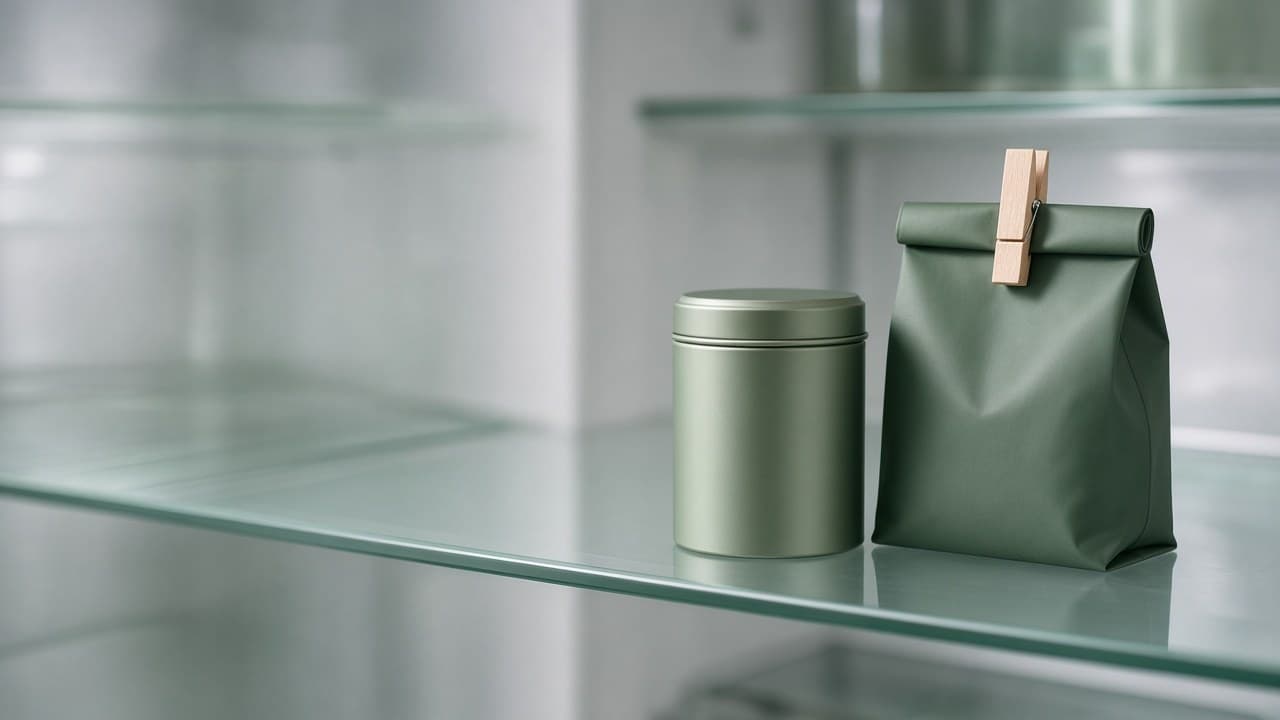
Matcha stays fresh longest if you keep it airtight, dark and cool. A fridge is possible but not a must: what matters is that the tin stays closed after you take it out until it has reached room temperature, otherwise condensation forms. After opening, it is best to use up the pack within a few weeks. Old powder often tastes flat, dull or bitter; if it smells musty, is damp, clumped from moisture or visibly mouldy, it belongs in the bin.
The enemies of matcha: air, light, heat, moisture
Matcha is a very fine powder of ground tea. Because of its large surface area it reacts to its surroundings faster than whole tea leaves. Four things affect it:
- Air: Oxygen makes colour and aroma fade. This is called oxidation. The powder then turns from bright green to dull, yellowish or brownish.
- Light: Sun and bright light bleach the colour. An opaque tin or a cupboard protects it.
- Heat: Next to the stove, a radiator or an electric kettle the powder ages faster. A cool spot is better.
- Moisture: Even a little water makes matcha clump and smell. That is why only a dry spoon belongs in the tin, and the tin does not belong near steam.
On top comes a fifth point that many forget: matcha picks up odours. Next to spices, coffee or cheese in the fridge, the powder can smell foreign.
So does matcha have to be refrigerated? Above all it has to be protected from these things, whether in the cupboard or in the fridge.
Tin or pouch, fridge or cupboard
Tin or pouch after opening
A tin with a well-closing lid is the simplest solution. It keeps its shape, lets no light through and is quickly closed again after each spoonful. A pouch works if it can be sealed reliably: press the air out, press the seal fully shut, and in addition put the pouch into a tin or an opaque container. A pouch on its own that is only folded over is not a good choice in the long run.
If you are looking for a replacement tin, pay attention to these things:
- lid with a seal or an inner lid
- opaque material (metal or opaque ceramic)
- clean and completely dry before the powder goes in
- no odours from earlier contents
Classic Japanese tea tins with an inner lid meet these points well: an additional inner lid seals the tin under the outer lid. They make most sense when you decant matcha from a pouch or divide a large pack. A simple metal tin with a tight lid serves the same purpose.
It is normal for matcha pouches sometimes to become electrically charged and for the powder to stick to the foil. That is down to the foil and the fine powder, not the quality. Tap the pouch out lightly or transfer the powder into the tin.
Fridge, cupboard or freezer
Unopened: A sealed pack keeps well cool and dark in the cupboard. You can also store it in the fridge if there is room. It is not necessary.
Opened: Here you have two workable ways.
- Dark, cool cupboard. This is the uncomplicated option if you use up the tin within a few weeks. No spot next to the stove or window.
- In the fridge, in an airtight tin. That is worthwhile if your kitchen is warm or you take a long time to get through a tin. What matters is the rule against condensation (see below).
Condensation: If you put a cold tin into the warm kitchen and open it at once, moisture condenses on the cold powder. This is the most common source of error when storing in the fridge. So take the tin out unopened, leave it closed until it no longer feels cool on the outside and no condensation is visible, then take the amount for the cup and put the tin straight back. That way it only warms up briefly.
Matcha tastes bitter or odd after the fridge: Usually moisture from condensation or absorbed foreign odours are behind it. Check whether the tin closes tightly and always let it warm up first before opening. If the powder is already damp and clumpy, it can no longer be saved: throw it away.
Freezer: For small amounts in everyday use this is rarely necessary. If you have a large pack and don't drink fast enough, you can freeze part of it in an airtight container. Then the same applies as for the fridge, only stricter: let it thaw until the closed container is fully at room temperature, and don't refreeze. It is best to divide the powder into small portions beforehand so that you only have to open each tin once.
Whether expensive matcha "for special occasions" should be hoarded sparingly: the longer an opened tin stands, the more it loses. A small tin that you deliberately and regularly use up is better than a large one that stands in the cupboard for a year.
After opening: how long it stays usable
We cannot name a fixed number of months here with any credibility, because it depends on the producer, the packaging and the storage place. Rely on this order:
- First the information on the packaging applies, above all the best-before date and any notes from the producer for after opening.
- If there is no information, the rule of thumb is: after opening, it is best to use it up within a few weeks.
- After that the taste worsens gradually, the powder gets flatter step by step.
That also covers the frequent questions from practice, for example about a tin you opened a year ago or a powder with a date from two years ago. Based solely on its age or taste, no one can give you a blanket assurance from a distance that such powder is still usable. Assess several points together: how long ago was the best-before date, how was the pack stored, was it exposed to moisture, and does the powder show anything unusual (see below)? If it smells musty, is damp, clumped from moisture or visibly mouldy, you throw it away. If you don't know how it was stored, don't use it when in doubt.
Matcha mixes with additions such as milk powder or flavourings often contain more sensitive ingredients, so the date counts especially here. If such a mix is far past the date, say by years, you no longer drink it when in doubt.
The same goes for very old tins that were found again somewhere in the cupboard, such as gifts whose brand no longer exists: here you know neither the storage nor whether moisture got in. Look at the date and the powder and smell it. If it smells musty, is damp, has damp lumps or mould, you throw it away. Even without such signs this holds: when in doubt, don't drink it.
Signs of old matcha
Whether matcha has oxidised you can see, smell and taste:
- Colour: Fresh matcha is bright, usually a juicy green. If it turns olive, yellowish green or brownish, it has lost freshness. Judge the colour in daylight and in comparison with a fresh tin, not under yellow kitchen light. The colour only shows freshness, on its own it says nothing about whether the powder is still usable.
- Smell: Fresh, matcha smells grassy, vegetal and slightly sweet. A slight sea or seaweed note can be typical of the variety (umami). A clearly musty or rancid smell, on the other hand, is a warning sign: then you throw the powder away. If it only smells dull, of dust or cardboard, it has lost freshness.
- Taste: Flat, without sweetness and without depth, plus a bitter or dull note: the powder is past its best.
- Texture: Damp lumps that can no longer be crushed, or a stuck-on rim on the tin point to water. You throw such powder away.
- Visible mould: Throw away at once, do not taste.
What happens in the worst case with expired matcha? With powder stored dry and showing nothing unusual, mainly the taste fades. A guarantee that a particular old tin is harmless cannot be derived from that, though. With moisture, mould or a musty smell, the tin belongs in the bin. A best-before date is a quality date, but when in doubt you have the last word: what smells odd, you don't drink.
Using up older leftovers: Matcha that was stored dry, looks and smells fine and has only become weaker in aroma, you can use for baking or in smoothies and milk drinks with a strong aroma. There the flatter taste is less noticeable. Musty, damp or mouldy powder does not belong in the kitchen but in the bin.
And a year on the tin? A powder that was harvested in 2025 can still taste good with good storage. The harvest year alone says nothing about whether the tin is still fresh. What matters is the best-before date, storage, time of opening and possible signs such as moisture or a musty smell.
Dividing a large pack (REFILL)
A large pack such as our REFILL with 100 g has an advantage on price but a disadvantage on freshness: you open it very often. At 2 g per serving it lasts for about 50 cups, so with daily use for many weeks. So that not every opening exposes all the powder to air, dividing helps:
- Open the pack on a dry day in a dry kitchen, not over steaming water.
- Fill part of it into a small, clean and dry tin, as much as you will use in the next few weeks. That is your everyday supply.
- Press the air out of the main pack, reseal it immediately and put it away dark and cool. Only open it when the small tin is empty.
- If you freeze or chill in portions: take the tin out and let it reach room temperature while closed before you open it.
That way most of the powder stays sealed. Every container must be completely dry before filling.
Reading best-before date and batch
On the pack, whether tin or pouch, you find two details that help with questions about freshness:
- Best-before date: Until this date, unopened and properly stored goods keep their typical properties according to the producer. It is not an expiry date. After it passes, matcha is not automatically unusable, but there is no guarantee either: check storage, appearance and smell, and throw away musty, damp or mouldy powder. The date applies to the unopened pack: after opening, the time since opening counts.
- Batch number (lot): It identifies which delivery the powder comes from. A sufficiently precise best-before date can replace the lot marking. Note the information down or photograph the pack if something catches your eye. Then, in case of queries, the goods can be identified quickly.
If the date is in the past, there is therefore no blanket answer. You check appearance and smell and pay attention to how the pack was stored and whether moisture got in. An unopened remainder stored dark and dry is to be judged differently from a tin that has been open for a long time next to the stove.
It happens that shops sell matcha with a near best-before date, and that is permitted, because the date is not a sales ban. So look at the date right after receiving it and ask the seller if it is shorter than expected. Buy an amount that you will use up within a foreseeable time: with small consumption 30 g (PURE) or 50 g (DAILY) fit, with regular consumption 100 g (REFILL).
Frequently asked questions
Does matcha have to go in the fridge?
No, it is not compulsory. Dark, cool and airtight is what matters. The fridge helps in warm kitchens but requires that the tin reach room temperature before opening, otherwise condensation forms.
Is matcha still good after a year?
That depends on packaging, storage and time of opening. Unopened and properly stored, it can still taste pleasant after a year; once opened, it loses flavour much faster. Check storage, colour and smell; you throw away musty, damp, moisture-clumped or mouldy powder.
Is an opened pack still usable after a year?
Usually only to a limited extent. After opening, it is best to use matcha up within a few weeks. After a year it is often flat and bitter. If it was stored dry and looks and smells fine, it is better suited to baking; if it is musty, damp, clumped from moisture or mouldy, you throw it away.
What happens in the worst case with expired matcha?
With dry-stored powder showing nothing unusual, mainly the taste fades, but that is not an assurance of safety. With moisture, mould or a musty smell, you throw it away. Assess date, storage and condition together and decide against drinking it when in doubt.
What do I do with expired flavoured matcha?
Flavoured mixes with additions are often more sensitive. If they are long past the date, smell odd or are damp, you no longer drink them. When in doubt, you throw them away.