How Much Caffeine Is in Matcha? Numbers, Ranges and What They Mean
Caffeine in matcha as a fact: range per gram, a worked example per serving, comparison with coffee and tea, EFSA safety levels and labelling.
Matcha naturally contains caffeine. According to published analyses, about 14 to 44 mg per gram of powder is typical; the value depends on the variety and the batch. For a serving of 2 g, that works out by calculation to about 30 to 90 mg. For our own batches we will only state a figure once an analysis value is available. This article puts the numbers in context: where they come from, how to calculate for your own bowl, how coffee and tea compare, and what the EFSA safety levels mean.
Where the numbers come from: literature ranges per gram
There is no single caffeine value for matcha. Analyses of different samples give ranges, and two published studies report these values for matcha powder:
- Caffeine per gram of powder
- 18.9 to 44.4 mg
- Caffeine per gram of powder
- 14.4 to 34.1 mg
In summary: according to published analyses, about 14 to 44 mg per gram is typical. Individual samples can differ considerably; Kika et al. 2024 [2] measured only about 2.2 mg per gram in one sample of their own. Another published paper states 71.5 mg of caffeine per 2.7 g of powder for the matcha used there (Baba et al. 2024, Nutrients) [7]; this lies within the range given. A range from the literature describes the category matcha, not a particular pack. Only an analysis of that specific batch can tell you what is in your tin.
When a retailer states a caffeine value, it is worth checking three things. First: does the figure refer to 1 g of powder or to a serving, and how big is that serving? Second: does the value come from an analysis of the batch or from general literature? Third: is the batch number given? Without this information, values from different retailers cannot be compared. For RINSUMILA DAILY, PURE and REFILL we state no caffeine value until an analysis value per batch is available. No caffeine value for our products can be derived from this; the literature range serves only as a general worked example.
Worked example per serving: 1 g, 2 g and the latte
The amount of caffeine in your bowl depends on the amount of powder, not on the amount of water and not on the milk. With the literature range of about 14 to 44 mg per gram, the calculation gives:
- Caffeine, by calculation from the literature range
- about 14 to 44 mg
- Caffeine, by calculation from the literature range
- about 30 to 90 mg
With Koicha, the thick preparation using 3 to 4 g of powder, the calculated value is correspondingly higher. A latte changes nothing in the calculation: 2 g of powder stays 2 g, whether plain with 70 ml of water or with 30 ml of water and 200 ml of milk. A batch-specific caffeine value requires an analysis.
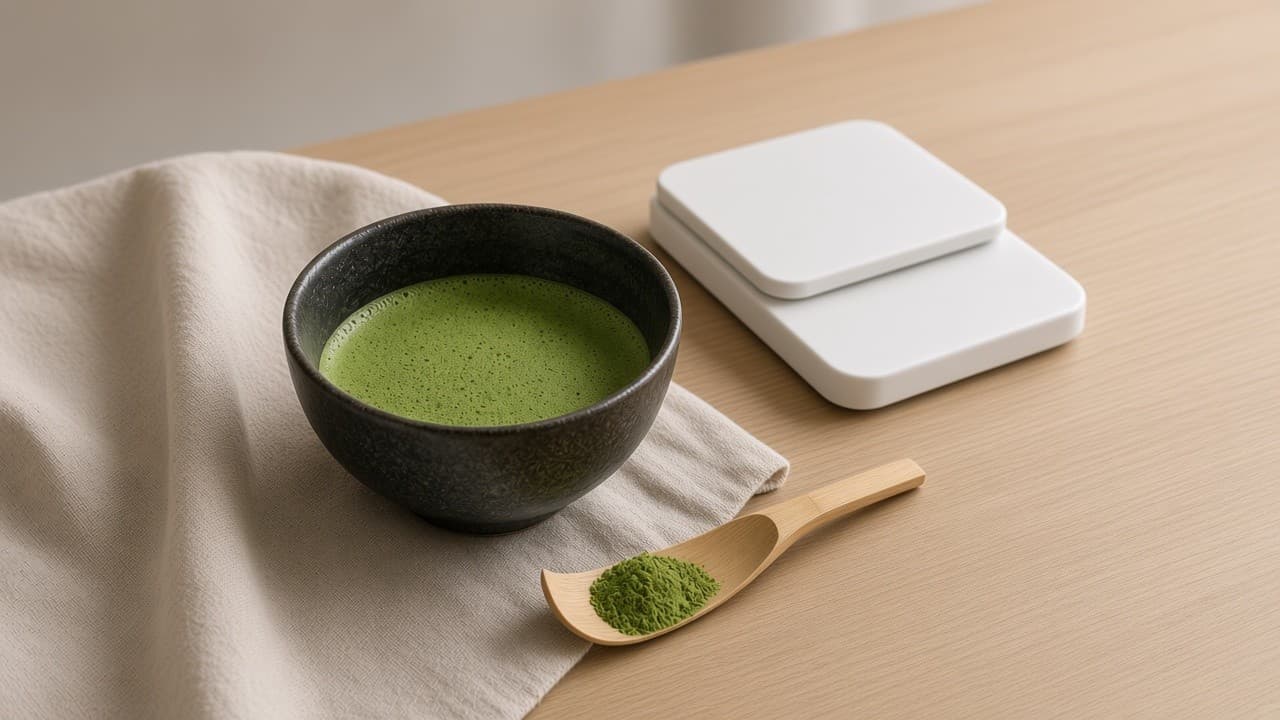
Here is how to calculate it yourself: amount of powder in grams times caffeine per gram. For that you need to know the amount of powder. A teaspoon or a Chashaku is not a measure, because spoons differ and powder sits more or less loosely. Weigh out 2 g once on a precision scale and remember what it looks like. How to adjust amounts for plain, latte and iced is described in the article Matcha amount, ratio and water temperature. If you know the serving weight and the matcha content of a mix, you can calculate the amount of matcha from them. The literature range then gives only a calculated value for that share; caffeine from other ingredients may be added. Without amounts, this calculation is not possible.
With our standard serving of 2 g, DAILY with 50 g gives about 25 servings; at €34.90 that is about €1.40 per serving (unit price €698.00 per kg).
Important: these are calculated values from a literature range, not measured values for a particular product. If you have an analysis value for your batch, calculate with that.
Matcha, tea and coffee compared in numbers
For orientation, here are the approximate values per serving given by the European Food Safety Authority (EFSA, 2015) [3] and the German Federal Institute for Risk Assessment (BfR, 2026) [4], without judgement:
- Serving
- one bowl or one latte
- Caffeine (approximate value)
- by calculation about 30 to 90 mg
- Source
- literature range, see above
- Serving
- 200 ml
- Caffeine (approximate value)
- about 90 mg
- Source
- EFSA 2015 [3]
- Serving
- 60 ml
- Caffeine (approximate value)
- about 80 mg
- Source
- EFSA 2015 [3]
- Serving
- 220 ml
- Caffeine (approximate value)
- about 50 mg
- Source
- EFSA 2015 [3]
- Serving
- 200 ml
- Caffeine (approximate value)
- about 30 mg
- Source
- BfR 2026 [4]
- Serving
- 355 ml
- Caffeine (approximate value)
- about 40 mg
- Source
- EFSA 2015 [3]
The ranges overlap. A bowl of matcha with 2 g may by calculation contain less caffeine than an espresso or about as much as a filter coffee; that depends on the batch. Amount and preparation change the values greatly on both sides: a large mug of coffee holds more than 200 ml, and anyone using 1 g of matcha halves the calculated value. That is why the table is suitable for a rough orientation, not for a ranking. What else changes when you switch, from taste to preparation, is described in From coffee to matcha.
With an infusion the leaves are removed, whereas matcha is consumed completely as a powder. A general ratio between the two drinks cannot be derived from that. How a drink is perceived is not the subject of this article.
Why the caffeine content varies
The range is wide because caffeine is a natural constituent of the tea leaf and its content depends on variety, harvest and batch. That is why batches differ even within one brand, and two tins with the same name do not have to have the same value.
Three things allow no conclusion about the caffeine content:
- The name: "Ceremonial" is not a protected term, more on this under Ceremonial, Premium, Culinary.
- The colour: Whether a powder is bright or dull green says nothing about how much caffeine it contains.
- The taste: A matcha with a strong taste does not automatically have more caffeine. Taste and caffeine content can only be determined separately, one with the tongue, the other in the laboratory.
Whether the matcha of a particular brand has more or less caffeine than another cannot be said without analysis values for both batches. Anyone who cares about this asks the retailer for the analysis report of the batch and makes sure that serving size and batch number are stated.
What the literature values say
Matcha naturally contains caffeine. The analyses mentioned give no general statement on decaffeinated products or their availability on the market. For the same batch, 1 g instead of 2 g halves the caffeine amount by calculation; no consumption recommendation follows from that.
For other drinks too, the same applies: whether a drink contains caffeine cannot be determined solely by whether the word "caffeine" appears in its list of ingredients.
EFSA safety levels: context, not a consumption recommendation
There is no official consumption recommendation for matcha, and we do not give one. To put caffeine amounts in context, EFSA assessed the safety of caffeine in 2015 [5]. The assessment refers to intake from all sources together, that is coffee, tea, matcha, cola, chocolate and other foods:
- Single doses of up to 200 mg and daily amounts of up to 400 mg give no cause for safety concerns in healthy adults.
- For pregnant and breastfeeding women, EFSA gives 200 mg per day as a safety level.
- For children and adolescents, EFSA proposes, because of limited data, 3 mg per kilogram of body weight for single doses and 3 mg per kilogram of body weight per day for regular intake as a safety level.
These are assessments for population groups, not an individual guarantee of tolerance and not a recommendation to use up these amounts. People with medical conditions or who take medication are not covered by the assessment (BfR) [4]. Sensitivity to caffeine is individual (BfR). If you notice symptoms, seek medical advice. What BfR and EFSA write about caffeine and symptoms can be found under Nausea or headache after matcha.
To put your own intake in context, what counts is the total caffeine of the day: a latte with 2 g of matcha provides about 30 to 90 mg by calculation, plus any coffee, black tea, cola or chocolate you drink or eat. The approximate values for these are in the table above; how to add them up is shown in the calculation aid with the EFSA caffeine values.
Labelling: why matcha does not have to carry a caffeine warning
For drinks with more than 150 mg of caffeine per litre, the Food Information to Consumers Regulation (Annex III) [6] provides for the statement "High caffeine content. Not recommended for children or pregnant or breast-feeding women" together with the content. Excepted are coffee- or tea-based drinks where "coffee" or "tea" appears in the name of the food. The rule also covers concentrated or dried drinks that, after reconstitution, contain more than 150 mg of caffeine per litre. Whether a prepared drink exceeds this threshold depends on its caffeine amount and its total volume.
Our name is "Matcha, gemahlener grüner Tee aus Japan" (Matcha, ground green tea from Japan). With that, the tea exception applies, and the statement is not mandatory. There is also no obligation to declare the caffeine content for tea; the nutrition declaration does not list caffeine. That is why the information is missing on many packs, even though consumer organisations call for it on all foods containing caffeine. We state a caffeine value for our batches only on the basis of an analysis value per batch; at present none is available.
What we do not write about caffeine
For caffeine there is no authorised health claim in the EU; the same applies to green tea and matcha as a food and to its typical constituents such as catechins. How L-theanine is regulated is described in the profile of L-theanine. That is why in this article we describe amounts, not effects: no statement on how the body absorbs caffeine from matcha compared with coffee, no statement on tolerance and no recommendation on when to drink it. Matcha is a food. Anyone with questions about their personal caffeine intake, for example because of a medical condition, a pregnancy or medication, seeks medical advice.
Frequently asked questions
How much caffeine does a serving of matcha have?
By calculation about 30 to 90 mg for 2 g of powder, derived from the literature range of about 14 to 44 mg per gram. The value for your tin depends on the variety and the batch; only an analysis value for that batch is reliable.
Does matcha have more caffeine than coffee?
That cannot be said across the board. A 2 g serving comes to about 30 to 90 mg by calculation, a 200 ml filter coffee to about 90 mg according to EFSA, an espresso of 60 ml to about 80 mg. The ranges overlap, and amount and preparation shift both sides.
Is there matcha without caffeine?
Matcha naturally contains caffeine. Whether a decaffeinated product contains a residual amount and how high it is cannot be determined from the literature values given here.
Does a latte have less caffeine than plain matcha?
Not with the same amount of powder. What matters is how many grams of matcha are in the drink; water and milk change nothing about that. 2 g stays about 30 to 90 mg by calculation, plain or in a latte.
How much matcha a day is fine?
We give no recommendation on that. As a safety level for healthy adults, EFSA gives 400 mg of caffeine per day from all sources together and 200 mg per single dose, for pregnant and breastfeeding women 200 mg per day. These are assessments for population groups, not an individual guarantee. If you notice symptoms, seek medical advice.
Is the caffeine content stated on the pack?
For tea it is not a mandatory statement, which is why it is often missing. We state a value for our batches only on the basis of an analysis value per batch; at present none is available. No caffeine value for our products can be derived from the literature range; it serves only as a general worked example.
Sources
- Kochman J, Jakubczyk K, Antoniewicz J, Mruk H, Janda K (2021): Review article; used for information on chemical composition, section 2.2. Molecules 26(1):85. DOI: 10.3390/molecules26010085.
- Kika J, Jakubczyk K, Ligenza A, Maciejewska-Markiewicz D, Szymczykowska K, Janda-Milczarek K (2024): Matcha Green Tea: Chemical Composition, Phenolic Acids, Caffeine and Fatty Acid Profile. Foods 13(8):1167.
- European Food Safety Authority (EFSA) (n.d.): Caffeine. EFSA, Topics. Caffeine assessment: 2015. Accessed 3 October 2026.
- Bundesinstitut für Risikobewertung (BfR) (2026): Fragen und Antworten zu Koffein und koffeinhaltigen Lebensmitteln, einschließlich Energy Drinks. BfR, Fragen und Antworten, 05.01.2026.
- EFSA Panel on Dietetic Products, Nutrition and Allergies (NDA) (2015): Scientific Opinion on the safety of caffeine. EFSA Journal 13(5):4102.
- European Parliament and Council of the European Union (2011): Regulation (EU) No 1169/2011 of the European Parliament and of the Council of 25 October 2011 on the provision of food information to consumers, amending Regulations (EC) No 1924/2006 and (EC) No 1925/2006 of the European Parliament and of the Council, and repealing Commission Directive 87/250/EEC, Council Directive 90/496/EEC, Commission Directive 1999/10/EC, Directive 2000/13/EC of the European Parliament and of the Council, Commission Directives 2002/67/EC and 2008/5/EC and Commission Regulation (EC) No 608/2004. Official Journal of the European Union L 304, 22.11.2011, p. 18.
- Baba Y, Takihara T, Okamura N (2024): Study; used only for the composition stated for the matcha used (caffeine per 2.7 g). Nutrients 16(17):2907. DOI: 10.3390/nu16172907.
More guides