L-Theanine in Matcha: What the Constituent Is and How It Is Regulated
Profile of L-theanine in matcha: amino acid of the tea plant, shading and Tencha, umami, caffeine as a fact and the status in the EU register.
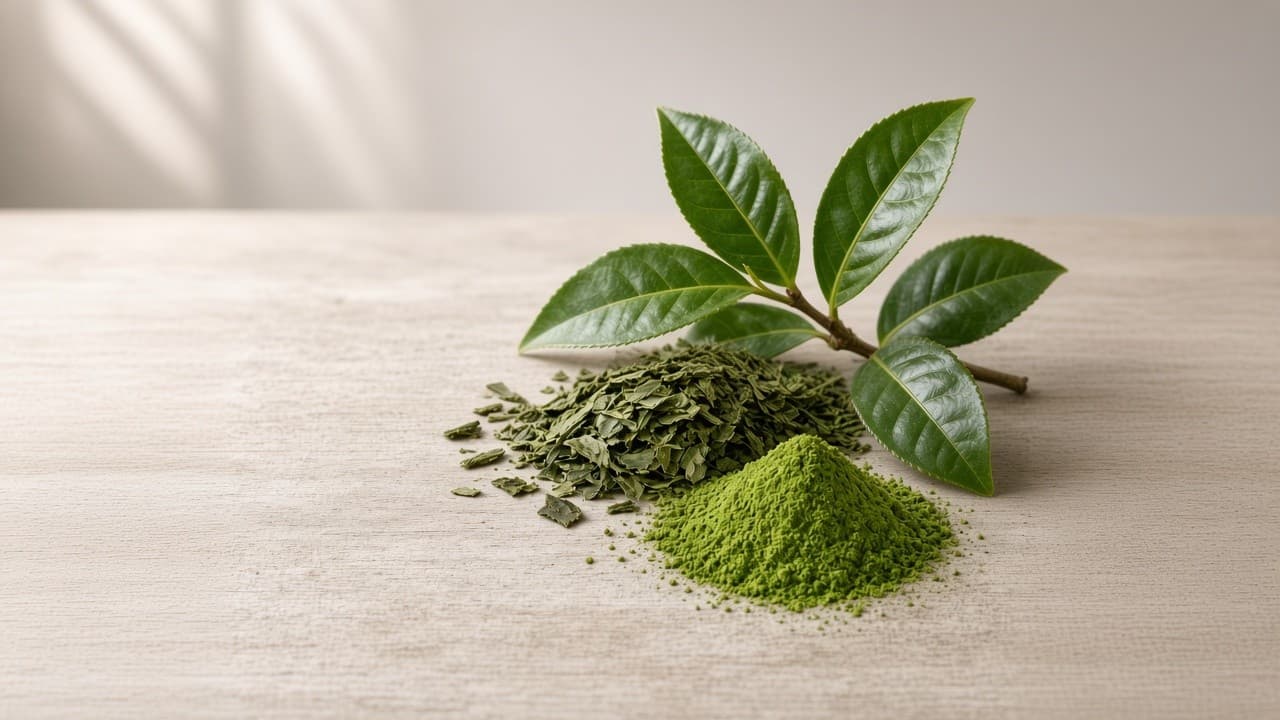
L-theanine is an amino acid of the tea plant and also occurs in matcha. Shading before the harvest helps to preserve theanine in the leaf. Together with caffeine, theanine shapes the taste and umami of matcha (Kochman et al. 2021, Molecules) [1]. This profile describes the substance, its origin in the leaf and its status in EU law. It does not describe an effect, because there is no authorised health claim for L-theanine in the EU.
What L-theanine is
L-theanine is an amino acid of the tea plant Camellia sinensis (Kochman et al. 2021, Molecules) [1]. In this article we also use the short form theanine. Because theanine is a constituent of the tea plant, it is not a special feature of matcha.
How much theanine a matcha contains cannot be said without measurement. Theanine is not part of the mandatory labelling under the Food Information to Consumers Regulation [2], and no theanine measurement exists for our batches. That is why we give no figures for the theanine content, either for our powder or in general.
Shading and Tencha: why matcha is shaped by it
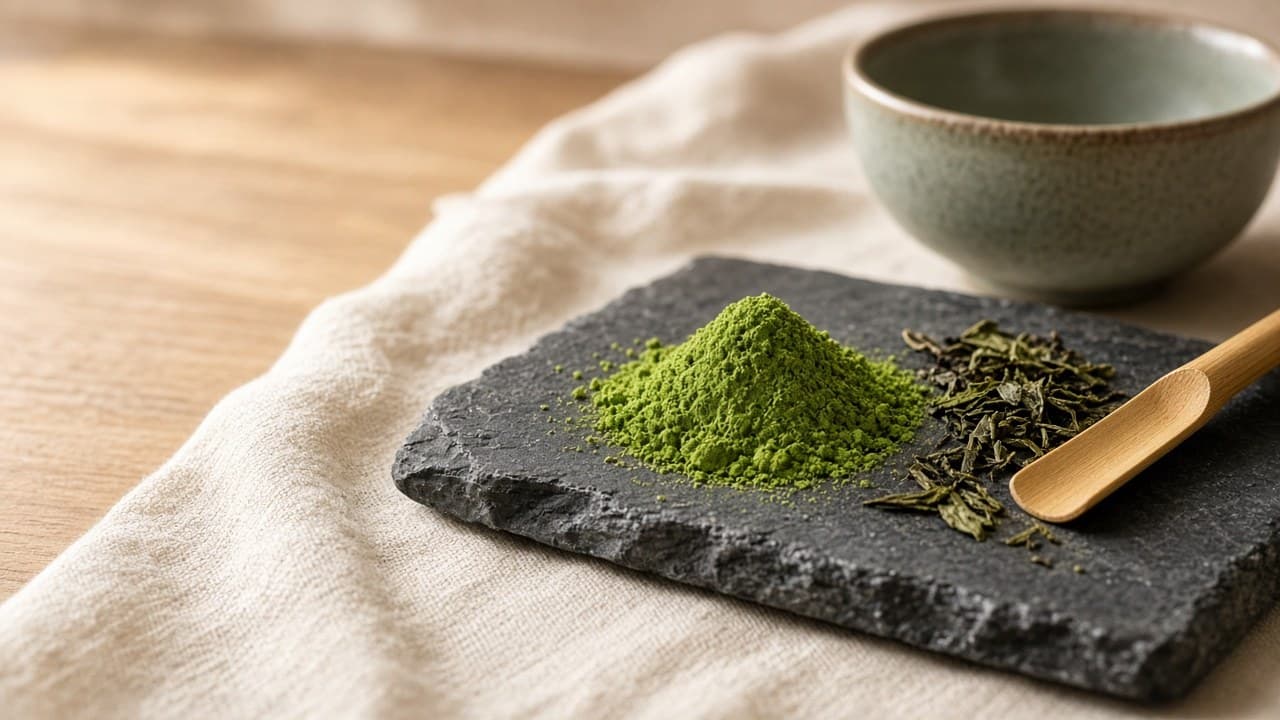
Matcha is finely ground powder made from Tencha. Tencha is tea leaves that are shaded before the harvest; Kika et al. 2024 (Foods) [3] give about three weeks under covers for this. How Tencha is made is described in What is matcha?.
Shading influences the constituent profile. Kika et al. 2024 (Foods) [3] describe higher theanine and caffeine contents and lower catechin contents with shaded cultivation. Kochman et al. 2021 (Molecules) [1] put it this way: in the shade, theanine in the leaf is not broken down, and the plant forms more amino acids, including theanine. That is the reason for the comparatively high theanine content of matcha that Kochman et al. 2021 describe. What happens in the plant is shown by a study on tea plants of the cultivar Lifeng (Niu et al. 2025): after shading, genes for the formation and transport of theanine were clearly more active, and the content of theanine and other amino acids increased significantly [7].
How long an individual producer shades is not stated on the pack; anyone who wants to know asks the producer or retailer. We give no ranking of varieties by shading duration.
For preparation, the powder is whisked with water. On our label, the plain preparation is 2 g of powder, sieved, to 70 ml of water at about 75 °C. How preparation and taste differ from coffee is described in From coffee to matcha.
Theanine and caffeine in the taste
The comparatively high theanine content shapes the taste of matcha; together with caffeine, theanine provides the taste sensation and the umami that is typical of this tea (Kochman et al. 2021, Molecules) [1]. Umami denotes a savoury taste, as you know it from soy sauce or dashi. Grassy, sweetish or nutty scent notes belong to the aroma, not to umami.
Shading influences the taste profile of matcha: Kika et al. 2024 (Foods) [3] report that shading increases the proportion of compounds responsible for the umami taste. From this, however, no rule of thumb for buying follows. You cannot reliably derive a theanine content from bitterness or price, and whether a powder tastes umami-forward enough for you is shown only by trying it. Notes on preparation are in the article on Matcha amount, ratio and water temperature.
Hot, cold or stored for a long time: what we can say about it
When you drink matcha, you consume the powder as well. Taking in the powder therefore does not require theanine to dissolve completely in the water; you do not need a special method to extract theanine from the leaf when using powder. Whether and how the water temperature changes individual constituents, we have not measured; we make no statement on that. For taste, our label applies: water of about 75 °C, not boiling.
On storage: how the theanine and caffeine content of our powder changes after opening, we cannot state without corresponding measurements. What you can check yourself are scent, colour and taste. Therefore, the practical rule remains: keep the pack closed, cool and dark, and preferably use the powder within a few weeks of opening. If the powder smells musty or is damp, throw it away.
Caffeine in matcha: the factual information
Matcha naturally contains caffeine. According to published analyses, the content in the powder is typically 18.9 to 44.4 mg per gram according to Kochman et al. 2021 (Molecules) [1] and 14.4 to 34.1 mg per gram according to Kolackova et al. 2020, cited in Kika et al. 2024 (Foods) [3]. By calculation, that gives a range of about 30 to 90 mg for a serving of 2 g. The value depends on the variety and the batch, and individual samples also lie clearly outside it: Kika et al. 2024 measured 2.2 mg per gram in their own sample. More on these numbers is in How much caffeine is in matcha?.
For RINSUMILA batches we will only state a value of our own once an analysis of the batch in question is available. Voluntary information such as a caffeine value must, under the Food Information to Consumers Regulation [2], be based on relevant scientific data; a value for a particular batch therefore requires an analysis of that batch, and a general literature range is not enough.
The caffeine amount of a serving depends on the amount of powder, not on water or milk; a latte with more powder contains correspondingly more caffeine. Anyone who wants to put their own serving in context weighs it (2 g is our standard serving) and calculates with the literature range; it can be done more precisely only with an analysis value for the batch. How to add up the caffeine of the whole day is shown in the calculation aid with the EFSA caffeine values.
Matcha contains theanine and caffeine. From the presence of both substances, their quantitative ratio cannot be derived; Kika et al. 2024 (Foods) [3] describe higher contents of both substances with shading.
For caffeine, too, there is no authorised health claim in the EU. We therefore describe amounts, not effects. Anyone who notices symptoms after drinks containing caffeine seeks medical advice. What BfR and EFSA write about caffeine and symptoms can be found under Nausea or headache after matcha.
How L-theanine is regulated in the EU
Whether a food or a constituent may be promoted with a health claim is regulated in the EU by Regulation (EC) No 1924/2006 (the Health Claims Regulation) [4]. Health claims in principle require an authorisation under that regulation and inclusion in the relevant legal list. This is subject to statutory transitional provisions; no entitlement to rely on them has been demonstrated for the claims dealt with here.
A health claim is any claim that "states, suggests or implies" a relationship between a food or one of its constituents and health (Art. 2(2)(5) of the Health Claims Regulation) [4]. Cautious wording such as "may" or "studies suggest" changes nothing about that, and individual studies do not replace the authorisation. That also applies to texts in a shop blog like this one, because they are part of commercial communication (Art. 1(2) of the Health Claims Regulation).
For L-theanine, such claims have been examined at EU level: in 2011 EFSA assessed submitted claims that linked L-theanine with cognition, stress, sleep and menstrual symptoms (EFSA 2011) [5]. In the EU register of nutrition and health claims, these claims are listed as "not authorised" [6]. The reason according to the register: the claimed effect was not substantiated on the basis of the evidence assessed.
The same applies to the other typical constituents: for green tea catechins, caffeine and L-theanine there are no authorised health claims in the EU; we therefore make no health promises. This profile describes the substance, its origin in the leaf and its share in the taste. Questions about what L-theanine "does" we do not answer, not even by pointing to studies or personal accounts. Isolated L-theanine as a food supplement is a different product and not the subject of this article.
Frequently asked questions
Does ordinary green tea also contain L-theanine?
Theanine is an amino acid of the tea plant Camellia sinensis (Kochman et al. 2021, Molecules) and thus not a special feature of matcha. How much an individual tea contains, we cannot say without a measured value; we give no figures on this.
Does bitter or cheaper matcha have less L-theanine?
That cannot be reliably derived from bitterness or price. Kika et al. 2024 (Foods) describe higher theanine and lower catechin contents with shaded cultivation; such a rule of thumb does not replace a measured value, and none exists for our batches.
Is L-theanine lost if I whisk matcha cold?
When you drink matcha, you consume the powder as well. Taking in the powder therefore does not require theanine to dissolve completely in the water. Whether the water temperature changes individual constituents, we have not measured; we give no information on this.
Why is there no theanine value on matcha packs?
Theanine is not part of the mandatory labelling under the Food Information to Consumers Regulation. No theanine measurement exists for our batches; that is why we give no figure for its content. The theanine content cannot be inferred from the price either.
Why does this article not describe an effect of L-theanine?
Because there is no authorised health claim for it in the EU. The claims on L-theanine assessed by EFSA in 2011 are listed in the EU register as not authorised, and in a shop blog this law applies to every sentence. That is why we describe the substance here, not an effect.
Is Tencha the same as matcha?
Not quite. Tencha is the shaded tea leaves from which matcha is made; Kika et al. 2024 (Foods) give about three weeks before the harvest for the shading. Matcha is the finely ground powder made from it, which is whisked with water and drunk with it. Powders from other leaves are not the subject of this article.
Sources
- Kochman J, Jakubczyk K, Antoniewicz J, Mruk H, Janda K (2021): Review article; used for information on chemical composition, sections 1, 2.2 and 2.8. Molecules 26(1):85. DOI: 10.3390/molecules26010085.
- European Parliament and Council of the European Union (2011): Regulation (EU) No 1169/2011 of the European Parliament and of the Council of 25 October 2011 on the provision of food information to consumers, amending Regulations (EC) No 1924/2006 and (EC) No 1925/2006 of the European Parliament and of the Council, and repealing Commission Directive 87/250/EEC, Council Directive 90/496/EEC, Commission Directive 1999/10/EC, Directive 2000/13/EC of the European Parliament and of the Council, Commission Directives 2002/67/EC and 2008/5/EC and Commission Regulation (EC) No 608/2004. Official Journal of the European Union L 304, 22.11.2011, p. 18.
- Kika J, Jakubczyk K, Ligenza A, Maciejewska-Markiewicz D, Szymczykowska K, Janda-Milczarek K (2024): Matcha Green Tea: Chemical Composition, Phenolic Acids, Caffeine and Fatty Acid Profile. Foods 13(8):1167.
- European Parliament and Council of the European Union (2006): Regulation (EC) No 1924/2006 of the European Parliament and of the Council of 20 December 2006 on nutrition and health claims made on foods. Official Journal of the European Union L 404, 30.12.2006, p. 9.
- EFSA Panel on Dietetic Products, Nutrition and Allergies (NDA) (2011): Scientific Opinion on the substantiation of health claims related to L-theanine from Camellia sinensis (L.) Kuntze (tea) and improvement of cognitive function (ID 1104, 1222, 1600, 1601, 1707, 1935, 2004, 2005), alleviation of psychological stress (ID 1598, 1601), maintenance of normal sleep (ID 1222, 1737, 2004) and reduction of menstrual discomfort (ID 1599) pursuant to Article 13(1) of Regulation (EC) No 1924/2006. EFSA Journal 9(6):2238.
- European Commission (n.d.): EU register. Food and Feed Information Portal Database, Health Claims. Accessed 3 October 2026.
- Niu X, Ao C, Teng R, Li H, Zhao Y, Yu J, Huang H (2025): Multi-omics analysis reveals the regulatory mechanism of shading on quality-related metabolites in Camellia sinensis cv. Lifeng. Food Chemistry: Molecular Sciences 11:100314.
More guides