Matcha Amount, Ratio and Water Temperature: Grams, Millilitres, Degrees
How much matcha per cup, how much water or milk and how hot: amounts for straight, latte and iced, the Chashaku in grams and the water temperature.
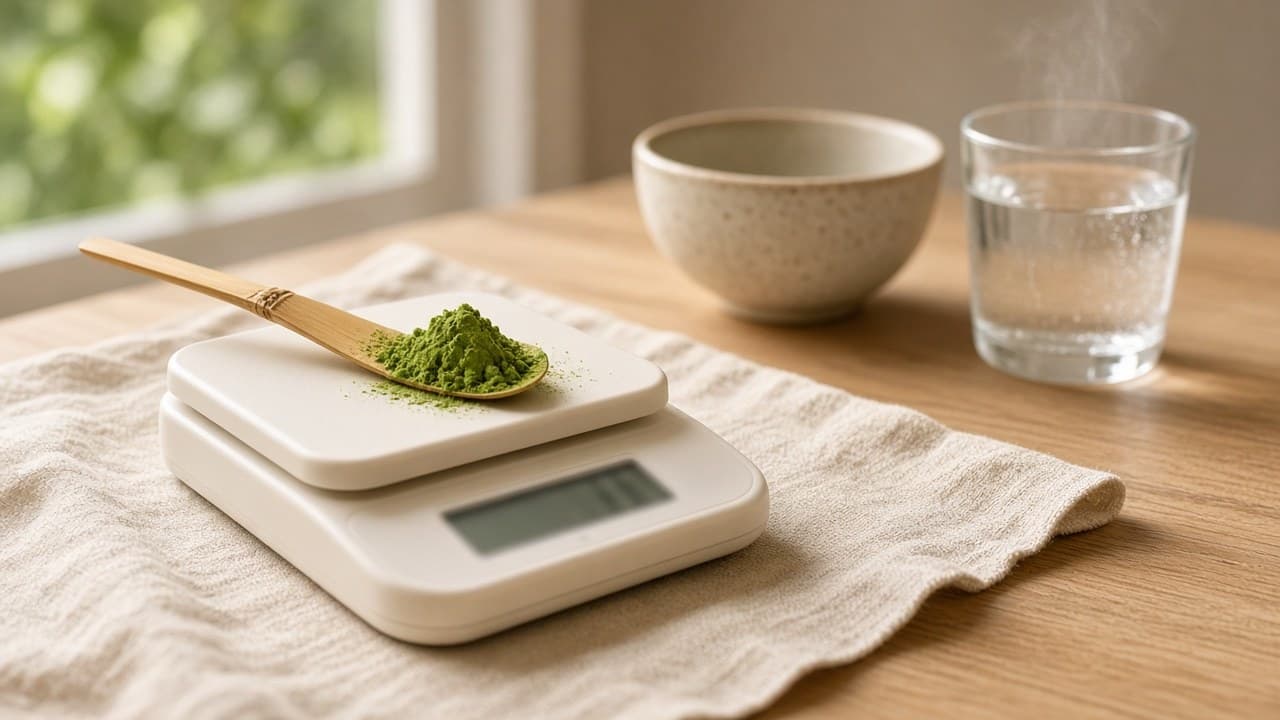
For a bowl of straight matcha you usually take 1 to 2 g of powder and 60 to 80 ml of water at 70 to 80 °C, not boiling. On our label: sieve 2 g and whisk with 70 ml of water (approx. 75 °C) to a fine foam. For a latte you take 2 g in 30 ml of water and top up with 200 ml of milk. Everything beyond that is a matter of taste, and the following sections show how you can adjust the amounts.
The standard amounts straight (g and ml)
Straight means: matcha and water, nothing else. This is the thin preparation, called Usucha in Japan. The usual amount is 1 to 2 g of powder to 60 to 80 ml of water. Our house amount is 2 g to 70 ml.
- Powder
- 1 g
- Water
- 70 ml
- Temperature
- approx. 75 °C
- Powder
- 2 g
- Water
- 70 ml
- Temperature
- approx. 75 °C
- Powder
- 2 g
- Water
- 60 ml
- Temperature
- approx. 75 °C
Matcha with water only is perfectly normal. In everyday speech people say "straight matcha" or Usucha. If you come from latte, straight feels unfamiliar at first, because no milk rounds off the aroma. Then it helps to start with 1 g and 70 ml, keep the water toward the lower end of the range (70 °C) and increase the amount step by step.
Is 1 g enough, or do you need 2 to 4 g? For the thin bowl 1 g is enough if you like it mild; 2 g is our house amount and tastes distinctly fuller. 3 to 4 g to 30 to 40 ml of water are the usual values of the thick preparation (Koicha), a type of preparation of its own. If you like your thin bowl stronger, use a little more powder; that is a personal variation. Matcha contains caffeine. If you want less powder per bowl, take 1 g instead of 2 g; the amount of water stays the same.
If the bowl seems "too empty" to you after whisking: that is normal. 70 ml is little liquid, the bowl looks half full and the foam makes up part of the volume. If you use clearly more water than the usual range, the matcha becomes milder and at some point tastes thin.
A few pointers to whether you are doing it right: the powder is sieved and free of lumps, the foam is fine and even, the surface shows hardly any large bubbles, and the taste is round rather than sharp. Matcha does not dissolve, it disperses as a fine powder in the water. That something settles at the bottom after a while is therefore normal. If dry lumps remain, on the other hand, it was usually not sieved or whisked too briefly. Typical beginner mistakes are unsieved powder, boiling water and too much water for the amount of powder.
Latte ratios
Our label value: whisk 2 g of matcha in 30 ml of water (approx. 75 °C), top up with 200 ml of milk or oat drink, over ice or warm. That is a ratio that scales easily.
- Stronger: a little more powder or a little less milk.
- Milder: a little less powder, if you are only getting to know matcha.
- Large mug: keep the ratio, so increase powder, water and milk by the same measure. Don't just stretch the milk, otherwise the latte tastes of milk and not of matcha.
If the milk covers the matcha for you, there are three usual causes: too little powder for the amount of milk, a powder that is too mild or a very strong-tasting milk. First try a little more powder. A milk with little taste of its own lets more matcha aroma through than a very aromatic variety. If a latte tastes of almost nothing, there is usually too little powder in play, or the powder has already been open for a long time.
For a hot latte you warm the milk but don't let it boil. Whisk the matcha in the 30 ml of water first and then pour in the milk. That avoids lumps more reliably than putting the powder directly into the milk. If you want to sweeten, syrup is the simplest, because it disperses more easily than sugar in warm as in cold milk. Add it sparingly and only after tasting, because too much sweetness quickly covers the aroma.
By "matcha syrup" is usually meant a sweetened matcha base: matcha is whisked in a little warm water and stirred with sugar syrup, then you add some of it to milk to taste. It is best prepared fresh, because the powder settles over time and the aroma fades.
If you want to move from latte to straight, go in stages: first less milk, then milk and water in equal parts, then straight with 1 g to 70 ml. That way you get used to the taste of the straight bowl.
Iced ratios
For iced the same basis applies as on the label: whisk 2 g of powder in 30 ml of water, then put ice in the glass and top up with 200 ml of cold milk. The ice melts and dilutes, so a little more powder can make sense if you drink slowly.
Whisking cold works too, but the powder then disperses more slowly and forms lumps more easily. It is more reliable to whisk with warm water (approx. 75 °C) first and only then add the cold milk. If you want layers, pour the matcha slowly over a spoon onto the milk last. If you like it sweeter, stir syrup into the milk before the ice.
Converting the Chashaku spoon to grams
A Chashaku is the small bamboo spoon for matcha. There is no fixed conversion to grams: spoons vary, and how much powder sits on it depends on grinding, looseness and how high you heap it. A levelled spoon gives less, a heavily heaped one considerably more. So weigh the 2 g once with a precision scale, count how many spoonfuls that is for you and remember the picture.
A teaspoon holds more than a Chashaku. Here too: because spoon and powder vary, the teaspoon is only good as a rough guide, not as a measure.
If you need a great many spoonfuls for one cup, something else is usually wrong: the powder is airy and loose, the spoon is only filled on the surface, or there is too much water. Measure in grams, then it quickly shows.
Kitchen scale or spoon
A precision scale makes you independent of spoon and scooping habit. In practice it goes like this: put the bowl with the sieve on the scale, zero it, put the matcha in the sieve and then push it through.
If you have no scale, the spoon works too: always use the same spoon and always heap it to the same height. The result then varies a little, but is good enough in everyday use. Only if the taste suddenly tips (too thin or too bitter) is it worth weighing again.
How far can you adjust amounts without it tipping? Small deviations, such as a slightly fuller heaped spoon, you notice in the taste, but they don't ruin the bowl. Only when powder and water clearly get out of proportion does the bowl become either watery or thick and bitter. With 1 to 2 g to 60 to 80 ml you stay within the usual range for straight.
Usucha and Koicha: thin and thick, amounts per preparation
Usucha is the thin variant: usually 1 to 2 g to 60 to 80 ml, with foam. Koicha is the thick variant: usually 3 to 4 g to 30 to 40 ml. Koicha is not whisked but slowly stirred, and gives a dense, almost syrupy consistency.
- Usucha
- 1 to 2 g
- Koicha
- 3 to 4 g
- Usucha
- 60 to 80 ml
- Koicha
- 30 to 40 ml
- Usucha
- thin, foamy
- Koicha
- thick, creamy
- Usucha
- whisk
- Koicha
- stir
How much is too much for a bowl? There is no fixed limit. Many find Usucha with more than 2 g to 60 to 80 ml quickly bitter and dense. If you like it strong, you can still use a little more powder or a little less water; what matters is that you like it.
Not every matcha is suitable for Koicha. Because the thick preparation is very dense, it needs a rather mild matcha. Whether a powder is intended for it is stated in the seller's information; when in doubt, ask before you try the thick variant. For everyday use Usucha is perfectly enough.
How often you drink Koicha is a question of occasion: it belongs mainly to the tea ceremony and is rather something special in everyday life. If you want to learn the tea ceremony (chanoyu or chado), you usually find lessons through local tea houses or cultural associations; for the kitchen at home you don't need that.
Whether a matcha is suitable for Usucha depends less on the name than on whether it tastes mild and round to you straight. Which bowl is the best remains a matter of taste: try out the different amounts and note what you like.
Water temperature: degree range and why
The usual range is 70 to 80 °C, not boiling. Our label says approx. 75 °C. That is warm enough for the powder to disperse well and the foam to form, and cool enough that the taste doesn't suffer.
Water that is too hot quickly makes matcha bitter, the fine aroma is lost and the foam becomes coarse. In clearly cooler water the powder disperses more slowly, and lumps form more easily. After whisking, the bowl is pleasantly warm; how hot you drink it is a matter of taste. If you prefer it lukewarm, wait a moment before taking the first sip.
Cooling without a thermometer, type of water and kettle
Without a thermometer you only get roughly into the range: boil water, pour it into a cup and let it cool briefly. Every pouring into another vessel cools it further, for example when you use it to warm the bowl. How fast that goes depends on the amount of water and the vessel; for exact values you need a thermometer. Water in this range is still very hot; so never test the temperature with your finger.
A temperature-controlled kettle is convenient but not a must. For the small amount of water you need for a bowl, an ordinary electric kettle or a pot is enough. When buying, make sure it also heats small amounts.
On the type of water: soft to medium-hard tap water or filtered water works well. Very hard water can taste a little heavier. You can try bottled still water; but it is not a must, and the difference is usually small compared with the difference that quantities and temperature make. If your tap water tastes good, use it.
When the pack is running low: servings per pack
At 2 g per serving it works out like this: 30 g is enough for about 15 servings, 50 g for about 25 and 100 g for about 50. With 1 g per serving you go correspondingly twice as far. If you are thrifty, use 1 g straight or 2 g for a latte.
Our DAILY with 50 g costs €34.90, which at 25 servings of 2 g is about €1.40 per serving. After opening, it is best to use it up within a few weeks. If a pack has been open for a while, the powder often tastes weaker; then a little more powder helps rather than more water.
Frequently asked questions
How high do I heap the Chashaku spoon?
There is no fixed rule, because spoon and powder vary. Weigh the 2 g once with a precision scale, count the spoonfuls and remember how high you heap for it. After that you can dose by this picture in everyday use.
Which water do I use for Usucha?
Good tap water or filtered water, not too hard, and at 70 to 80 °C, not boiling. The water itself should taste of nothing, because matcha does not cover a foreign taste.
How many teaspoons of matcha a day?
We give no recommendation on that. For one serving, use 1 to 2 g. How much of that fits on a teaspoon varies; weigh the amount once with a precision scale.
Which ratios do I use for an iced latte, and which milk?
Whisk 2 g of matcha in 30 ml of water, put ice in the glass, top up with 200 ml of cold milk. Which milk you use is a matter of taste; a milk with little taste of its own lets more matcha aroma through.
Straight or curved tines on the Chasen for Koicha?
For Koicha you usually take a Chasen with fewer, thicker tines. Whether they are straight or curved is secondary at home; what matters is that you stir the dense powder evenly.