Shading, cultivar, grinding: what studies from 2024 to 2026 show about the taste of matcha
What studies from 2024 to 2026 show about shading, tea variety, grades and whisking matcha, and what is known about grinding.
Studies from 2024 to 2026 show three things above all: shading makes the tea leaf build up more amino acids, the tea variety (cultivar) shapes the astringency more than processing does, and powders with the designation ceremonial differ measurably in composition from cheaper powders, although the term is not protected. How fast and how long matcha is whisked also changes its aroma and astringency. On grinding, we found no comparison study with published results; here we only describe the process.
Literature status: October 2026.
How we selected the studies
The basis is a search of the PubMed literature database for papers with "matcha" in the title from 2023 to 2026 (79 hits), supplemented by individual papers from other databases. We checked every cited paper via its DOI. We only included what concerns cultivation, composition and taste. Studies on what happens in the body are not the subject of this article.
Three limitations apply to all results:
- Several papers examine Chinese tea varieties or matcha from China. What applies to these samples cannot simply be transferred to Japanese matcha.
- The results apply to the samples examined, not to every tin on the market.
- Laboratories measure constituents and have trained panels taste the samples. Whether you like a matcha is still shown only by your bowl.
Shading: more amino acids, more chlorophyll
For tencha, the raw material for matcha, tea farmers cover the plants for about two to three weeks before the harvest, with reed screens, straw mats or fabric sheets [1]. Because of the missing light, the content of chlorophyll, which gives the leaves their green colour, rises [2].
A study from 2025 examined what happens in the leaf [3]. The researchers shaded tea plants of the Lifeng variety and then found significantly more amino acids in the leaves. At the same time, genes linked to the build-up of amino acids were more active. The paper sums up the state of knowledge as follows: shading promotes the accumulation of amino acids and slows down the formation of catechins.
This matters for taste because amino acids contribute to umami and sweetness, while catechins contribute to astringency. The abstract does not report a sensory comparison between matcha made from shaded and unshaded leaves. What was measured were constituents and gene activity in the leaf, not the taste of finished matcha.
Not every tea variety copes equally well with shading. According to the research service of Japan's upper house, the leaf of Yabukita, the most widespread variety in Japan, often does not turn a bright green under shade, and the plant suffers [2]. That is why Japan promotes varieties that grow well even when shaded and do well in colour and taste, such as the Seimei variety registered in 2020; in 2023, however, it grew on only 130 hectares, 0.4% of the area [2].
Cultivar: the variety shapes the astringency
How much the tea variety counts is shown by a paper from 2025 [5]. The researchers made matcha from two Chinese varieties (Longjing 43 and Zhongcha 108), tracked 679 flavonoids through processing and had the astringency tasted. Their result: the variety is the most important factor for astringency, while processing plays a lesser role. Drying did increase the content of certain flavonoids, but which variety the leaves came from remained decisive.
A second paper from 2024 compared matcha from four varieties, including the Japanese variety Okumidori [4]. The content of polyphenols, catechins and amino acids differed between the varieties. Among 1,383 non-volatile compounds, the researchers found 177 that differed significantly, and 97 aroma compounds that contribute to the scent.
For you as a buyer, this means: two matcha powders can differ considerably, even if both are sold as "Japanese matcha". Which variety is in a powder is stated only in the producer's information.
Grades: what laboratories measure for the terms ceremonial and culinary
Several papers have compared powders of different grades. Important first: ceremonial is not a protected designation, and every producer sets its own grades. So the studies measure what was in their samples sold under this term.
- Samples
- three grades with the designations ceremonial grade 1, grade 4 and food grade
- Result on composition
- amino acids and caffeine decrease from the highest grade to food grade, polyphenols increase
- Samples
- ten powders with the designation ceremonial or culinary, as hot water extracts
- Result on composition
- more chlorophyll and caffeine in the samples with the designation ceremonial, more phenolics in the culinary samples
- Samples
- fifteen green teas, including matcha with both designations
- Result on composition
- among the matcha samples, more phenolics in the cheaper culinary powders than in the powders with the term ceremonial
The authors of the 2025 study see the time of harvest and the age of the leaves, among other things, as influencing factors [6]. For taste, this fits the picture from shading: more amino acids tend to mean umami and sweetness, more phenolics tend to mean astringency.
Can grades be measured objectively at all? A paper from 2024 recorded matcha with images in visible and near-infrared light and trained a computer model on them [9]. It assigned the samples to the correct grade in 98.10% of cases and was able to visualise differences in catechins, free amino acids, caffeine, soluble protein and soluble sugars. So grades do differ measurably. There are still no binding values for what a grade must contain; every producer sets its own grades. Only an analysis of that specific batch shows what a tin contains.
Whisking: speed and duration change aroma and astringency
A paper from 2024 examined how whisking changes the taste [10]. Instead of a bamboo whisk, the researchers used a laboratory stirrer and varied the speed and duration. At a low speed (500 revolutions per minute) and 30 seconds, the aroma was richest in the tasting. At the same time, these samples tasted more bitter and more astringent. As an aroma compound with a large influence, the paper names 2,4-decadienal, which is associated with a sweet, roasted and seaweed-like scent; the researchers attributed bitterness and astringency mainly to flavonol glycosides, and umami and sweetness to gallic acid and gallocatechin.
Whether this transfers one to one to the chasen was not tested in the study. But it does show in the laboratory that the way of whisking helps determine the taste. At home, the proven range still applies: whisk briskly for about 15 to 30 seconds until a fine foam forms, and then taste whether you like the result.
The seaweed note: what is behind it
Some matcha powders smell and taste of the sea or seaweed. A paper from 2025 decoded this note in high-grade matcha from the Chinese province of Shandong (Zhongcha 108 variety) [11]. Eleven volatile compounds contributed significantly to the aroma. In experiments in which the aroma was rebuilt and individual compounds were left out, dimethyl sulfide and alpha-ionone proved to be the most important carriers of the seaweed note, along with hexanal, benzaldehyde and beta-ionone.
For you, this means: fishy or seaweed-like notes can be typical of the variety and belong to the profile of some powders. A clearly musty or rancid smell, on the other hand, is a warning sign.
Grinding: what is known, without a study
Matcha is tencha that is ground into a fine powder with millstones or other mills [1]. How scarce grinding capacity has become is described by the research service of the upper house: grinding is a separate step with its own mills, these mills are lacking, and some tea merchants are looking into handing the grinding over to flour mills [2].
We cannot back up with a study what role the grinding method plays for the taste. We did find a paper from 2023 on a new type of mill, but without an accessible abstract, so it is left out here. Fineness and heating depend on the mill and its settings, and leaf material, shading and sorting also play a part. You cannot reliably tell the method from what is in the bowl.
What this means for RINSUMILA
Our three matcha powders are ground green tea from Japan. We will only put region, cultivar, shading duration, harvest time and grinding method on the product page once the producer has confirmed them to us in writing. Until then, you will find the best-before date and lot number on a sticker on every pack; you can look up your batch via the QR code.
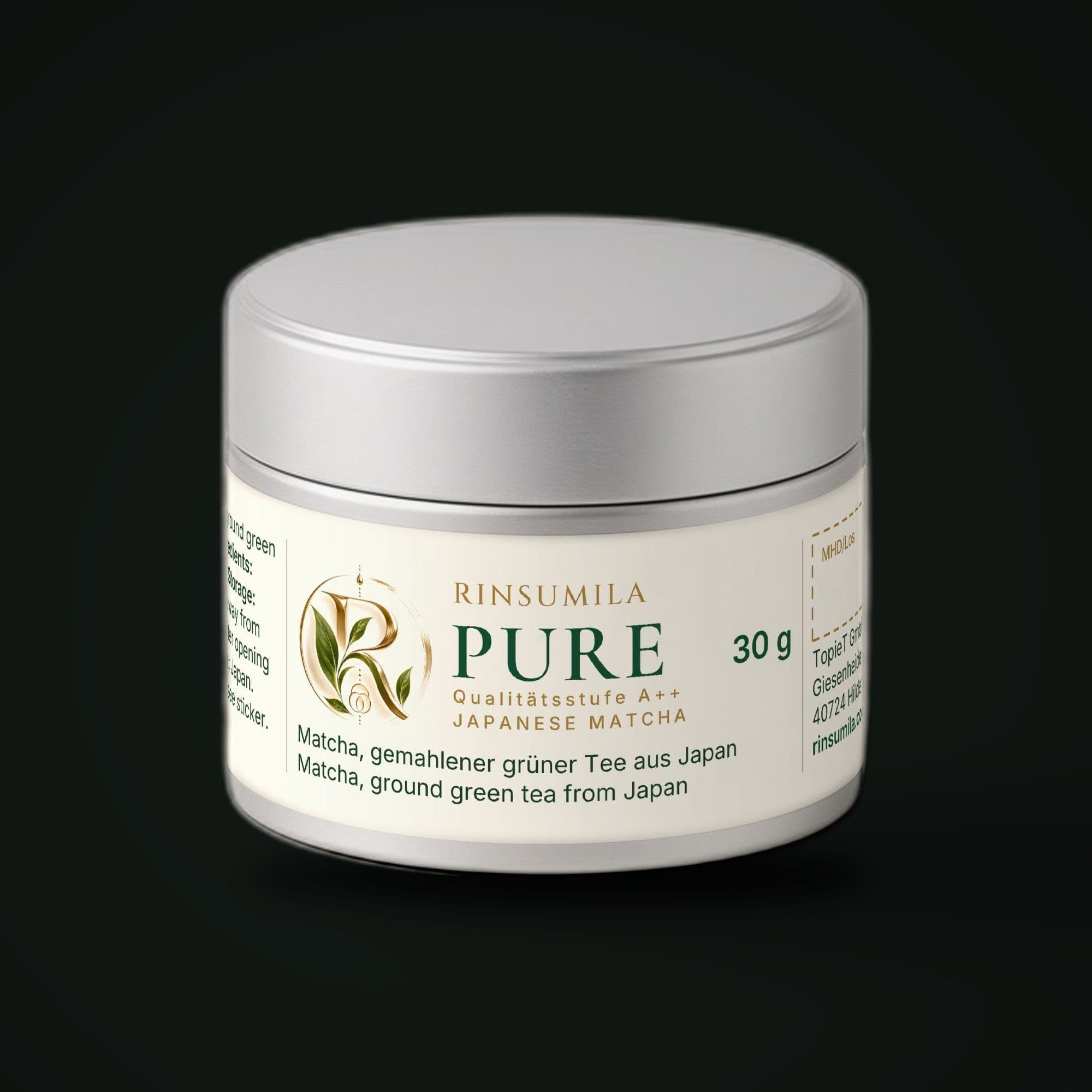
For the bowl, whisked plain with water, RINSUMILA PURE is the one to use: sift 2 g of matcha, whisk with 70 ml of water at about 75 °C, in the 30 g tin for about 15 bowls. How shaded leaves become tencha and tencha becomes matcha, and which growing regions Japan has, is covered in the guide What is matcha?.
Frequently asked questions
How long is matcha shaded?
Japan's agriculture ministry gives about two to three weeks before the harvest for tencha. The exact duration varies from farm to farm. Which duration a particular matcha had can only be found in the producer's information.
Which tea varieties are used for matcha?
In Japan, Yabukita is the most widespread, but it does not always cope well with shading; varieties such as Seimei are therefore being promoted. Studies have examined, among others, the Japanese variety Okumidori and Chinese varieties such as Longjing 43 and Zhongcha 108. In one study, the variety determined the astringency more than processing did.
What do studies measure in powders with the designation ceremonial?
In the samples examined, powders with this term contained more amino acids, chlorophyll and caffeine, and cheaper culinary powders more phenolics. But ceremonial is not a protected designation, and every producer sets its own grades. Only an analysis of that batch shows what a particular tin contains.
Does matcha taste different depending on the mill?
Possibly, but we cannot back it up: we found no comparison study with published results. Fineness and heating during grinding depend on the mill and its settings, and variety, shading and sorting also play a part. You cannot reliably tell the grinding method from what is in the bowl.
Sources
- Ministry of Agriculture, Forestry and Fisheries (MAFF) (2026): 茶をめぐる情勢 (Japanese). Tea situation report, July 2026.
- Tokunaga H (2025): 茶の輸出拡大 -抹茶供給体制の現状と課題- (Japanese). 立法と調査 No. 480, pp. 87-96, research service of Japan's House of Councillors, 02.12.2025.
- Niu X, Ao C, Teng R, Li H, Zhao Y, Yu J, Huang H (2025): Multi-omics analysis reveals the regulatory mechanism of shading on quality-related metabolites in Camellia sinensis cv. Lifeng. Food Chemistry: Molecular Sciences 11:100314.
- Huang D, Chen X, Tan R, Wang H, Jiao L, Tang H, Zong Q, Mao Y (2024): A comprehensive metabolomics analysis of volatile and non-volatile compounds in matcha processed from different tea varieties. Food Chemistry: X 21:101234.
- Xue J, Liu P, Xu Y, Gui A, Wang X, Ye F, Feng L, Wang S, Teng J, Gao S, Zheng P (2025): Laboratory study on the astringency of matcha from two cultivars; used for the comparison of cultivar and processing. Food Research International 204:115954. DOI: 10.1016/j.foodres.2025.115954.
- Toniolo C, Patriarca A, De Vita D, Santi L, Sciubba F (2025): A Comparative Multianalytical Approach to the Characterization of Different Grades of Matcha Tea (Camellia sinensis (L.) Kuntze). Plants 14(11):1631.
- White HM, Meyer BR, McCormack JD, Lawson HP, Niemeyer ED (2025): Laboratory comparison of matcha powders with the designations culinary and ceremonial; used for chlorophyll, caffeine and phenolics. Journal of Food Measurement and Characterization 19(9):7070-7079. DOI: 10.1007/s11694-025-03448-7.
- Meyer BR, White HM, McCormack JD, Niemeyer ED (2023): Laboratory comparison of commercially available green teas; used for the phenolic contents of the matcha samples. Plant Foods for Human Nutrition 78(4):662-669. DOI: 10.1007/s11130-023-01121-2.
- Hu Y, Yu H, Song X, et al. (2024): Comprehensive assessment of matcha qualities and visualization of constituents using hyperspectral imaging technology. Food Research International 196:115110.
- Li S, Tian H, Zhu G, Wei Z (2024): Laboratory study on whisking matcha with a laboratory stirrer; used for aroma, bitterness and astringency at different speeds and durations. Current Research in Food Science 9:100843. DOI: 10.1016/j.crfs.2024.100843.
- Zhang Y, Wu X, Shi Y, Qu F, Qi D, Qian W, Zhang X, Hu J (2025): Identification of key odorants responsible for the seaweed-like aroma quality of Shandong matcha. Food Research International 204:115945.
Related products
Related recipes
More guides