How to Recognise Good Matcha: Colour, Smell, Texture and Authenticity
How to recognise good matcha: colour, smell, powder and behaviour in water, plus signs of Sencha powder and what to check in a seller's information.
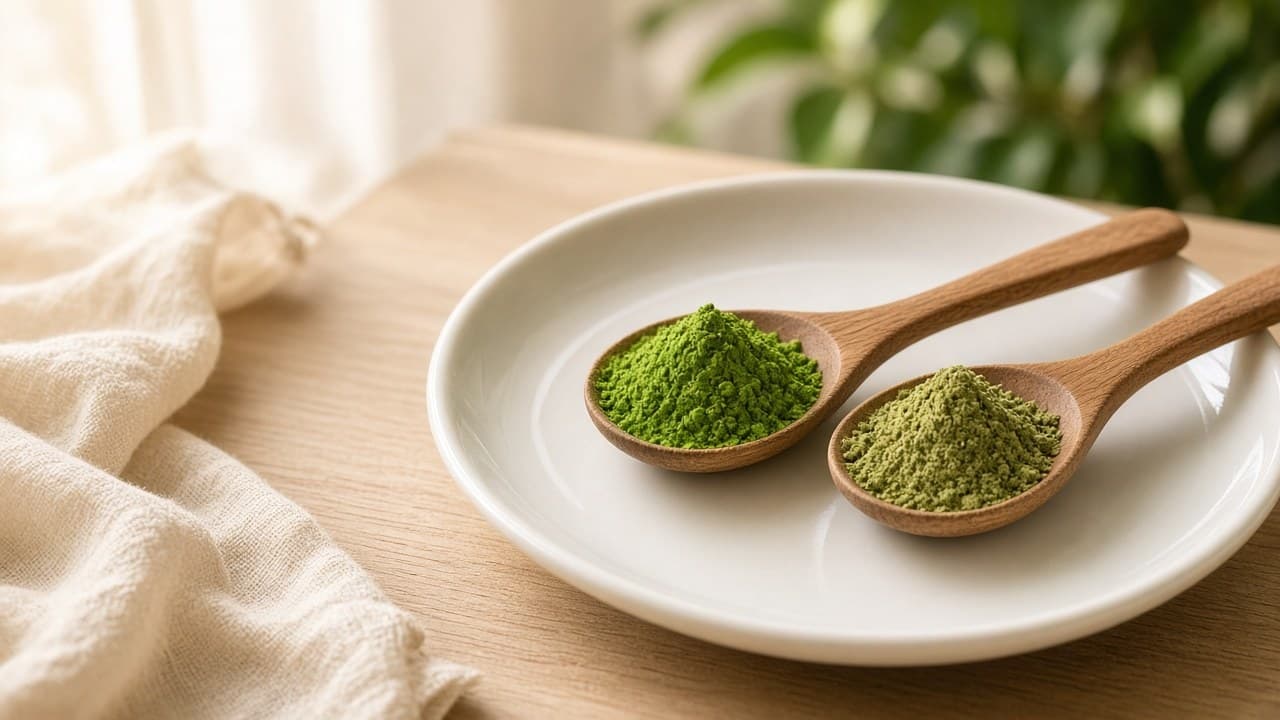
Good matcha is a fine, evenly green powder with a fresh, grassy-sweet scent that binds into a fine foam after whisking. No single property proves quality, but several features together say a lot. This article shows you what to look for in colour, smell, texture and seller information, and what cannot be judged from a photo.
Colour: bright green, yellowish or brown
Matcha is ground from shaded tea leaves (Tencha). The shading is what gives the intense, cool green. Fresh powder ranges, depending on the batch, from rich emerald green to a somewhat more muted green. A slight difference between two tins is normal, just as coffee or wine differ from year to year. If a freshly opened tin is a little more yellowish than the previous one, that can be down to the batch. If the tone stays clearly yellow and the powder tastes flat or bitter, that points more to a different base material or long storage before sale.
Why is my matcha yellowish or brown? There is usually one of these reasons:
- Age and air: Matcha oxidises. If you open the tin often or store it warm or in light, you will see the green fade over the weeks. That also explains a shade that has "changed a bit".
- Different base material: Powder from unshaded leaves, such as ground Sencha, looks yellowish or olive green (more on this further below).
- Roasting or other types of tea: Reddish or brownish tones do not fit fresh matcha. A red-brown powder is either heavily aged or not classic matcha at all, but for example roasted tea.
- Light and screen: Phone cameras, warm light and filters change colours a lot. A photo in the kitchen looks different from the same powder in daylight.
How bright does the colour have to be? It does not have to be neon. A very glaring, almost artificial tone is more a reason to ask questions. An even, lively green without grey, yellow or brown tinges is a good guide. An ashy, grey-green powder, as you sometimes know it from the supermarket shelf, has usually been stored for longer or comes from simpler base material. Colour alone does not show whether the powder is still usable. So also check how it was stored, how it smells and whether it is dry. If it smells musty or is damp or clumped from moisture, throw it away.
Matcha also looks lighter in the glass or in milk than in the tin. A pale latte is therefore no proof of bad powder, but often simply a question of quantity: with 2 g of matcha to 200 ml of milk the shade is light, with more milk lighter still. Straight matcha also looks pale if you add a lot of water to a little powder or have not sieved the powder and lumps stay at the bottom.
Smell and powder texture
How do I smell freshness? Open the tin and smell it deliberately. Fresh matcha smells grassy, slightly sweet, sometimes a little of seaweed or spinach. That is normal. These speak against it:
- a musty, dusty or papery smell,
- a smell of hay or smoke that does not fit the product,
- a foreign smell, for example of spices or coffee from the kitchen cupboard, because matcha picks up odours easily.
A clearly musty or rancid smell is a warning sign: you throw such powder away, as well as powder that is damp, clumped from moisture or visibly mouldy. A slight seaweed or sea note, on the other hand, can be part of the variety.
The smell fades over the weeks after opening, so it is best to use up matcha within a few weeks and keep the pack closed, cool and dark.
Texture: Good grinding feels soft and flour-like between the fingers, almost like face powder. The powder clumps easily because it is so fine; with a sieve the lumps can be loosened well. If it feels grainy, fibrous or gritty, it is probably not finely ground or is made from coarse material.
How the powder behaves in water
The water test says more than any photo. Sieve 2 g of powder into a bowl and whisk it with about 70 ml of water at around 75 °C to a fine foam, not with boiling water. Then look at the following:
- Foam: Fine, dense foam speaks for fine powder and the right technique. If there is no foam, it is more often the preparation than the matcha. Typical mistakes are lumps from not sieving, water that is too hot or too cold, and too little movement when whisking. Whisk from the wrist in loose zigzag movements rather than in circles, for about 15 to 30 seconds.
- Settling: Matcha is not a solution but a suspension. After a short time part of it settles. That is normal. Very fast settling with clear water above points to coarse particles.
- Milky or cloudy: A milky impression is normal with matcha, because the finest particles float in the water. It depends on the ratio of powder to water.
- Taste: Fresh matcha tastes vegetal, with a fine sweetness and some umami. A strong, dry bitterness and a rough aftertaste fit coarse or old powder better, but water that is too hot or too much powder also make it bitter.
What does colour say about taste? The green gives a hint about leaf quality and condition, but no reliable hint about taste. A bright powder can taste bitter, a somewhat more muted one mild. Grinding, freshness and preparation are what matter, so a trial sip is worth more than a look at the packaging.
Sencha powder or fake matcha: how to tell
Can you spot fake matcha? Yes, in some cases. There is no protected quality grade behind "matcha", and shops also offer powder from ground Sencha or another green tea under this name. That is something different from matcha made from shaded Tencha leaves. Signs of it:
- Colour: yellowish, olive green or brownish instead of cool green.
- Texture: grainy and fibrous, less soft to the touch.
- Whisking: hardly any foam, the powder sinks quickly, the taste is grassy-bitter and astringent.
- Price: Very low prices are a warning sign. As a guide: 30 g of Japanese matcha costs around €19 to €49 in shops. If an offer is far below that, ask what is in the powder. If a 50 g pack costs less than other sellers charge for 30 g, that is such a case. The price alone proves nothing either way, though.
Even powder "from Japan" can vary greatly in quality and grade, and buying on the spot in Kyoto does not yet guarantee high quality. Powder from other growing countries is not automatically bad, but you should know where it comes from. A seller who does not name the origin gives you no way to check.
Counterfeit packaging occurs with well-known Japanese tea houses, including in shops on the spot. Typical signs are sloppy printing, differing fonts, a missing batch number and a point of sale with no recognisable connection to the producer. If in doubt, ask the producer itself.
Checking the seller's information
A reputable seller makes it easy for you to verify the information. Check:
- Origin: Is the growing region named, not just "Made in Japan" or the company's location? Growing and processing can take place in different countries. If a seller says so openly, that is a good sign. If "from Japan" is on the page but the growing country or place of processing remains unclear, ask before you order.
- Legal notice (Impressum) and contact: Name, address and a quick way to get in touch, plus commercial register and VAT ID, where available.
- Authorised retailer: A named source alone does not yet prove authorisation. If you want to be sure, buy directly from the producer or check whether the seller is listed in the producer's retailer directory. If there is no such directory, have the producer confirm the authorisation. Outside Europe, for example in Canada, local tea shops or specialised online shops that expressly confirm delivery to your country are an option. Pay attention to shipping costs, import charges and delivery time, and ask about origin and batch before you order.
- Batch information: Best-before date and lot or batch are on the pack; a sufficiently precise best-before date can replace the lot marking. A certificate of analysis for every batch is a plus if the seller can show it.
- Designations: "Ceremonial" is not a protected term, and neither is "traditional grade". The same applies to statements about harvest times or blends: they only help if the seller can substantiate them. Look at the information on origin, variety and intended use, not at the label alone.
- Seller sites: Recommendation lists for shops only help if you check the criteria above yourself.
- Unknown sources: Matcha from the supermarket, from drugstores or as a gift can be judged by the same criteria. The powder is not automatically bad, but age and storage are often unknown.
The details of our own varieties are on the respective product page, for example for RINSUMILA DAILY (pouch with 50 g, €34.90, €698.00/kg). PURE comes in a tin with 30 g for €39.90 (€1,330.00/kg).
What colour does not prove
Is colour a quality feature or just social media? Both are true to a degree. Colour is a hint, but not proof. A rich green on social media can be light, filters or image editing. A less glaring green can still be good, fresh powder. Whether a particular matcha is good can therefore not be said from a photo alone. Colour does not prove:
- the origin or the region,
- freshness, because even a pretty powder can be old,
- the taste,
- whether a powder is genuine, because forgers can imitate colours.
How do cafés get such bright green matcha? There are several possible reasons: good light, small amounts that are used up at once, light glasses, ice or milk foam as a backdrop and practised preparation. This cannot be said in general, so the picture in the café is no yardstick for the tin at home.
The most reliable approach is the combination of colour, smell, grinding, trial sip and the seller's information. If two or three of these points do not fit, ask before you buy a larger pack.
Frequently asked questions
How do cafés get such bright green matcha?
Usually it is a mix of good light, fresh powder in small amounts and practised preparation. The photo in the café is therefore not a reliable comparison for home.
Is a muted green bad?
Not automatically. A slightly muted, even green can belong to the variety, the light or the preparation. Look rather for grey, yellow or brown tinges and at how the powder smells and whether it is dry.
The colour looks odd. What now?
Compare the colour in daylight and with freshly opened powder if you have some. Yellowish, brownish or grey tones point to age, exposure to light or air, or a different base material. If the powder smells musty, is damp, clumped from moisture or visibly mouldy, throw it away.
Where do I buy matcha online from an authorised retailer?
The safest option is to buy directly from the producer or from a seller who is listed in the producer's retailer directory or whose authorisation the producer confirms. Outside Europe, for example in Canada, local tea shops or specialised online shops that expressly confirm delivery to your country are an option. Check shipping costs, import charges and delivery time beforehand and ask about origin and batch.
Is there fake matcha on the market?
Yes, mainly powder from ground Sencha or other green tea sold as matcha, and imitation packaging. Yellowish or brown colour, grainy texture, missing foam and an unclear origin are signs. In the end, certainty comes from the combination of several features and a seller who backs up the information.