Matcha Tools: Chawan, Chasen, Chashaku, Sieve and Which Set Is Worth It
Which tools you need for your first bowl of matcha, what matters in bowl, whisk, spoon and sieve and when a matcha set is worth it.
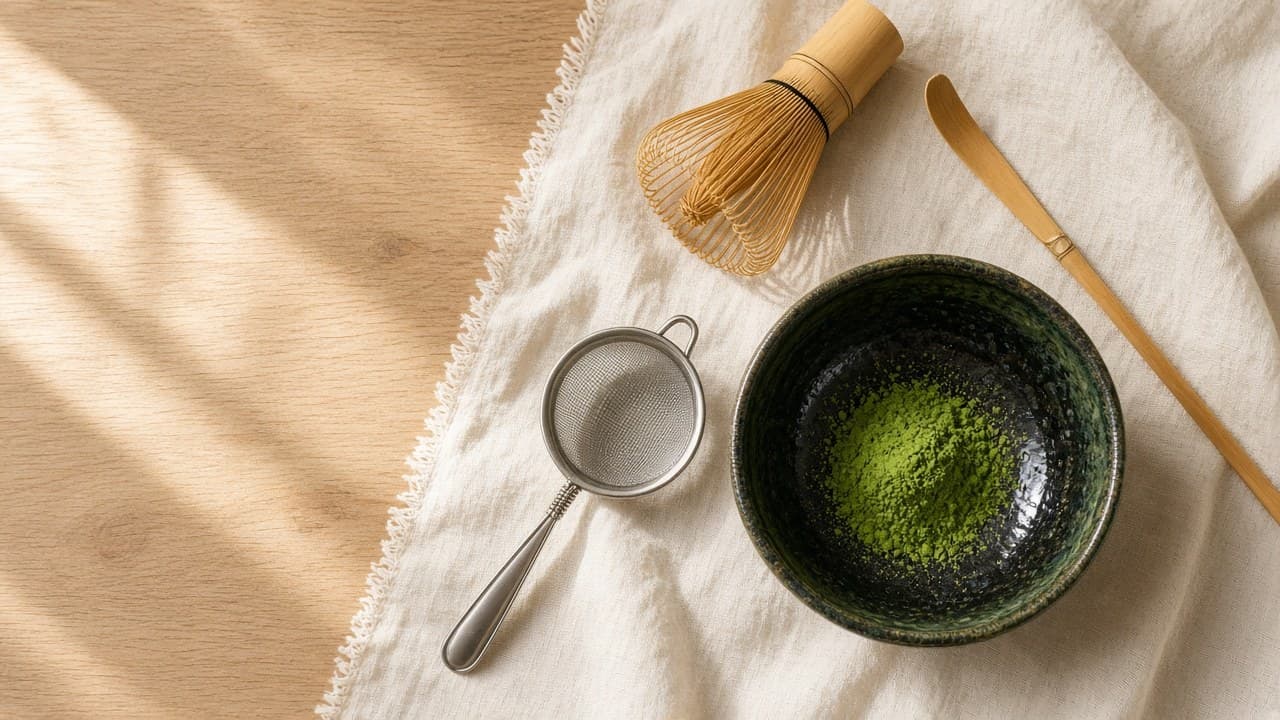
For a first bowl of straight matcha you need matcha, a wide bowl, a bamboo whisk (Chasen) and a sieve. The bamboo spoon (Chashaku) makes measuring more pleasant but can be replaced by a scale. For a latte, a screw-top jar or a milk frother will do if need be. A matcha set is worth it if you need all the parts at once and don't want to gather them one by one.
What you need and what you don't
Recommended for the first bowl of straight matcha: matcha, bowl, Chasen and sieve. With these, whisking works most reliably. The sieve breaks up lumps before the water goes in. Without a sieve, small pockets often stay in the powder even with a good whisk. The process: sieve 2 g into the bowl, whisk with 70 ml of water (approx. 75 °C) to a fine foam, moving the whisk loosely from the wrist in quick zigzag movements.
For latte you don't need the whole set. Stir 2 g of matcha smooth with 30 ml of water (approx. 75 °C) in a glass, either with a milk frother or by shaking everything vigorously in a screw-top jar. Then top up with 200 ml of milk or oat drink, over ice or warm. That also works for a latte to go in a thermal cup. The Chasen gives finer foam but is not a must for the latte.
How much equipment counts? Equipment makes a difference in three places: lumps (sieve), foam (whisk) and feel in the hand (bowl). Everything else is decoration or habit. As a beginner you are better off with a few good pieces than with many mediocre ones.
Why a Chasen? The fine bamboo tines break up lumps and bring air into the water. That creates a fine foam. With a spoon or a wire whisk this works less reliably.
Does an ordinary whisk work instead of a Chasen? For latte, yes. For the straight bowl usually only with compromises: the foam is coarser and the powder disperses less well. The most usable emergency solution is a small electric milk frother.
Is the Chasen suitable for other powder drinks? Technically yes, for other fine powders in water or milk. But bamboo can pick up flavours, so a whisk of its own just for matcha is the cleaner solution.
If you are starting completely new: If you already have a suitable bowl, the START RITUAL is the simplest way; without a bowl you take the FULL RITUAL, which includes the bowl. If you just want to test first, you also get by with matcha, sieve and a milk frother.
Cheap sets from marketplaces: Very cheap packages often contain powder of unclear origin and whisks with few, coarse tines. For every offer, ask: where does the powder come from, how many grams are included, which parts belong to it and is a bowl included? Only then can a set be compared sensibly, including another provider's starter set.
What to look for in materials: With bamboo look for unvarnished surfaces, with bowls for a smooth, odour-free glaze and with every part for a clear statement of materials. Varnished, strongly smelling or unlabelled parts you had better leave.
Bowl: glass RIN and ceramic AKENO
The bowl (chawan) is what you hold most often. It should be wide enough for the whisk to work freely and hold considerably more than the 70 ml of water of the straight preparation so that nothing spills. There is no fixed size in ml. As a rule of thumb: the water fills only the lower part of the bowl, and the whisk has room all around. A narrow cup makes whisking tiresome because the tines hit the wall.
Glass (RIN): You see foam and colour from the side, the bowl is easy to clean and does not pick up odours.
Ceramic (AKENO): The green-gold glaze gives it a handcrafted look. It has a dark interior against which the green foam stands out well. You only see the foam from above. After use you rinse it with water and let it dry completely.
Differences between bowls: There are flat, wide bowls and deeper, narrower ones. Wide bowls give the whisk more room and are easier for beginners to handle. Deeper, narrower bowls are more often used for the thick preparation.
Does my Chasen fit the bowl? The whisk should fit in with a little room all around. If it is too big, it catches on the edges and the foam becomes uneven.
Where do you get bowls? From potters, in tea shops, at craft markets and in online shops with tea accessories. With us there is the glass bowl RIN and the ceramic bowl AKENO. Always check: smooth inner glaze, a stable base, no cracks or chips, no odour.
Handmade bowls and one-offs: The same checklist applies. A hand-painted bowl or one bought on a trip is a lovely piece, but should be smooth inside and free of hairline cracks so that it can be cleaned well. You order a bowl to your own design from the potter, the wait is usually longer.
Determining the origin of a bowl: First look at the stamp on the foot. It usually names the workshop or the potter. If accompanying papers or a labelled wooden box are included, have the inscription translated: it often states workshop, place and the name of the bowl. Without a stamp and papers, the origin can hardly be determined from a photo alone.
White deposits in the glaze: A white coating in fine glaze cracks is usually limescale from hard water. Dissolve it with diluted citric acid or vinegar water, rinse thoroughly and let the bowl dry completely. If the coating stays or the bowl smells, you had better use it only as decoration.
The large bowl from the tea shop: A bowl that is clearly larger than a chawan and sold as a water bowl is usually a kensui. In the tea ceremony, the rinse water from the tea bowl is poured into this vessel. It is not intended for whisking matcha.
If a bowl breaks: Ceramic can be glued or repaired in a workshop with the kintsugi technique. For bowls you drink from or that come into contact with matcha, the repair should expressly be food safe. When in doubt, the bowl remains decoration afterwards.
Taking it travelling: In hand luggage you pad the bowl with a cloth, put the Chasen in with the cap upward and pack the powder tightly.
Chasen, Chashaku and sieve
Chasen: Look for fine, even tines and clean workmanship on the bamboo. Whisks with a long, narrow handle are intended for mugs and tall glasses, for example for latte. That is a question of shape, not quality: what matters is the tines. A holder (kusenaoshi) keeps the tines in shape but is not a must, even with a long handle. Without a holder you stand the whisk upright on its handle to dry, in an airy place, and don't put it damp into a closed tin. After use you rinse it with lukewarm water, without detergent, and let it dry. That individual tines break over time is normal with bamboo. If a whole ring breaks soon, the workmanship was weak. You find long-lasting whisks at tea specialists, with dense tines and smoothly cut tips.
Chashaku: The bamboo spoon is slightly curved. The curve points toward the bowl when measuring and helps to strip off the powder. How much powder fits on a spoon varies with the spoon and the filling. So weigh 2 g once with a precision scale and note how many spoonfuls that is with your Chashaku.
Sieve: A fine sieve over the bowl, plus a small spoon to push the powder through. You sieve the 2 g directly into the bowl before the water goes in.
START RITUAL versus FULL RITUAL
The START RITUAL costs €80.90 and contains RINSUMILA DAILY (50 g), Chasen, Chashaku and sieve. It suits you if you already have a suitable bowl at home.
The FULL RITUAL additionally includes a bowl, either the glass bowl RIN for €119.90 or the ceramic bowl AKENO for €124.90. You choose the bowl when buying. If you need everything new, you get all five parts in one package.
For context: DAILY 50 g (in the pouch) gives about 25 servings of 2 g, which is about €1.40 per serving. After that you only buy powder again, the accessories stay.
Buying individually or as a set
A set is worth it if you need everything: the parts together cost less in the set than individually, the individual prices are on the product pages. You also don't have to collect the parts one by one. You buy individually if something is already there or you replace selectively, for example a worn whisk or a chipped bowl.
For the powder, the usual market price for 30 g of Japanese matcha is around €19 to €49, the range is wide. Work it out for every set: how much powder, which parts and what shipping. With us shipping within Germany costs €4.90 and is waived from €49.
As a gift
A set is practical as a gift because nothing is missing. If you don't know what the person already owns, take the FULL RITUAL with a bowl. If they already have bowls, the START RITUAL is enough. Which bowl fits better depends on taste: glass looks clear and modern, ceramic handcrafted.
If you put together a gift from individual parts, matcha, Chasen, sieve and bowl belong in it, the Chashaku is a pretty extra. Nothing more is needed. If you are looking for a set outside Europe, for example in Australia, first look in local tea shops and at specialised online shops that expressly confirm delivery to your country. Pay attention to shipping costs, import charges and delivery time and ask about the origin and batch of the powder. We deliver to the EU, Monaco, Switzerland and Liechtenstein; you can see the countries at checkout.
Frequently asked questions
Where do I get a chawan?
In tea shops, from potters, in online shops with tea accessories and from us as the glass bowl RIN or the ceramic bowl AKENO. Look for a smooth inner glaze, a stable base and no odour.
Where can I buy a matcha bowl?
Anywhere you can look at tea accessories: tea shops, pottery markets, specialist retailers and online shops. Check material, glaze and width. To start, a wide, smoothly glazed bowl without decoration inside is enough.
How full should I fill the Chashaku?
There is no fixed amount, because spoon and filling vary. The usual amount is 1 to 2 g per bowl. Weigh 2 g once with a precision scale and count how many spoonfuls that is for you.
What is a matcha kit?
A kit bundles powder and accessories: usually Chasen, Chashaku, sieve and optionally a bowl. The START RITUAL and the FULL RITUAL are such kits.
What do I look for in a set in Japan?
Smooth glaze, clean tines on the Chasen and clear information on origin. Ask what is a souvenir and what is suitable for everyday use, and think before the journey back about how to get bowl and whisk home intact.