Iced Matcha: Whisking Cold, Ice, Milk, Layers and On the Go
Iced matcha works with 2 g of powder, 30 ml of water and ice. How to whisk cold, layer, prepare ahead and take it with you without lumps.
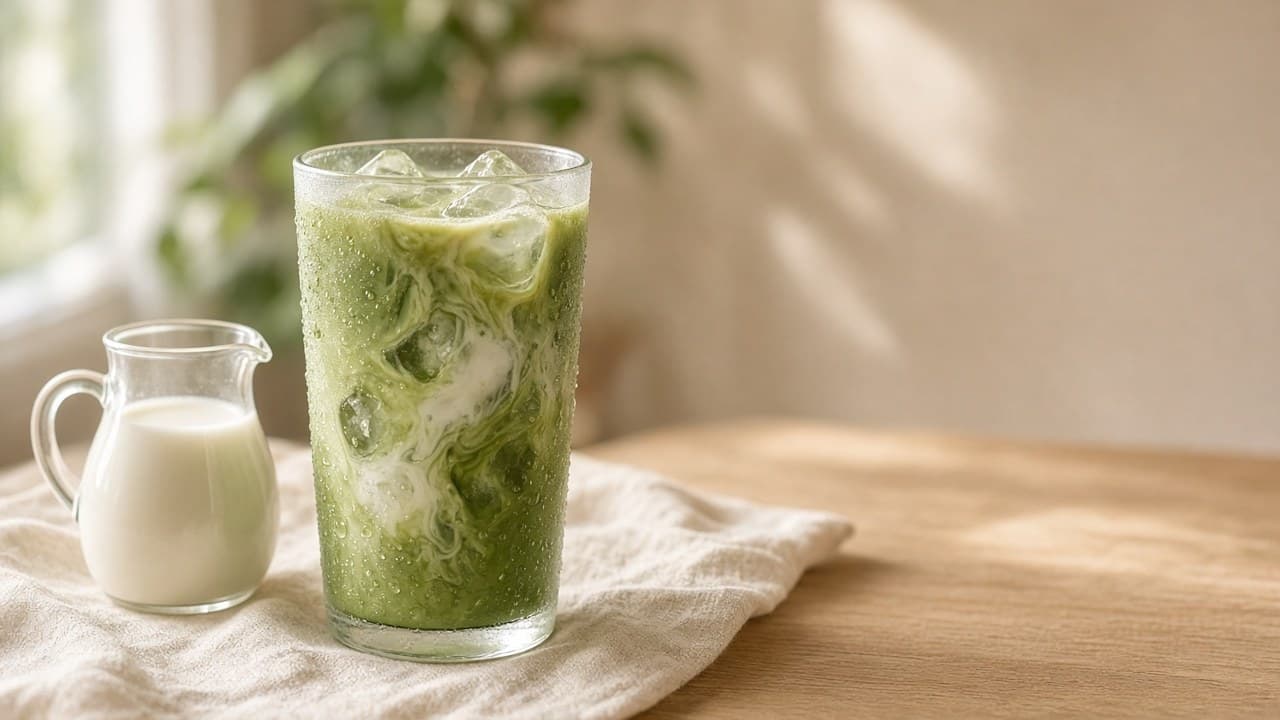
For one glass of iced matcha, sieve 2 g of matcha, whisk it smooth with 30 ml of water and pour the base over ice. Then top up with cold water or, for a latte, with 200 ml of milk or oat drink. Whisking cold works, but it needs a fine sieve and a bit more vigour than warm. On the go, take the powder dry in a small tin and mix it on the spot.
Basic iced matcha recipe (g, ml, ice)
The basic recipe for one glass:
- Put 2 g of matcha through a fine sieve into a bowl.
- Add 30 ml of water. Cold, room temperature or lukewarm all work, more on that shortly.
- Whisk with the bamboo whisk or a frother into a smooth, foamy base.
- Fill the glass with ice cubes and pour the base over them.
- Top up with cold water to taste. If you like it stronger, use less water; if you like it milder, dilute it with a little more water.
On the amount of ice: rather fill the glass properly with ice than only half full. Plenty of ice keeps the drink cold without the individual cubes quickly breaking down. Large cubes melt more slowly and dilute less than small ones or crushed ice. If you let the drink stand for a long time, it will still become more watery. So plan it more for drinking promptly.
Which powder is suitable? For an iced latte a more robust powder is fine, because milk and ice soften the taste. For iced matcha with water only, a milder, fresh powder usually tastes more pleasant, because nothing covers it here. In both cases it should be finely ground and not stale. One powder for latte and iced is, for example, RINSUMILA DAILY. A 50 g pouch lasts for about 25 servings of 2 g each, which is about €1.40 per glass.
First a dense base, then dilute
The most important step with iced matcha is the order: first whisk the powder smooth with a little water, then dilute. If you throw the powder straight into a large glass with ice and liquid, it easily stays in clumps or settles at the bottom.
That also answers the question of whether matcha dissolves in cold water or in ice water. Strictly speaking, powder does not dissolve, it disperses finely in the liquid. That works well cold if you have first whisked it into a base with the small amount of water. If you instead sprinkle the powder straight into a glass of ice water, it often floats on top or clumps unless you shake it vigorously.
For the same reason, a "cold brew" only works to a limited extent. Matcha is not steeped and poured off like tea, you drink all of the powder. A dense base for preparing ahead still works: whisk the powder with a little water and chill it tightly sealed. The powder does settle over time, though, and has to be shaken up again before drinking.
Whisk cold, or mix hot and cool down
Both work, and neither is a wrong method.
Whisking cold: 2 g of powder with 30 ml of cold or room-temperature water. The powder takes a little longer to disperse. Sieving and vigorous whisking matter more here than with warm water. In return the base is cold and ready to drink at once and often tastes clearer, without the warm aroma.
Mixing hot and cooling down: You whisk 2 g of powder with 30 ml of water at about 75 °C, as for the latte. The powder then usually disperses more easily and the foam is finer. Then you pour the base over ice, which cools it down straight away. The downside: the ice melts a bit more.
If you are unsure, try both ways side by side. It is a matter of taste. Is it odd to drink matcha with room-temperature water? No. Many people even find water without ice a little rounder. Warm water is not essential either: the powder only has to be whisked thoroughly so that no lumps remain. The usual range for warm preparation is 70 to 80 °C, not boiling.
Iced latte with milk and layers
Our basic recipe for the iced latte: 2 g of matcha, whisked in 30 ml of water, plus 200 ml of milk or oat drink. With plant drinks it is better to choose a barista version. It froths and tastes less thin, so the matcha does not taste watery. If the latte with plant drink tastes too flat to you, use a little less milk or sweeten lightly rather than using more powder. "Ceremonial", by the way, is not a protected term.
The order for clean layers, from bottom to top:
- If you want it sweet: put syrup or sugar into the empty glass first and stir it with a little milk.
- Ice cubes up to just below the rim.
- Slowly pour cold milk over the ice cubes.
- Last, carefully add the whisked matcha base over the back of a spoon or directly onto the ice. It stays on top and runs down in streaks.
- Stir before drinking.
Dispersing matcha directly in cold milk without taking water first works most reliably with a frother or shaker. With a spoon it is less reliable, lumps easily remain and no foam forms. The small amount of water beforehand is more reliable, and cold water is enough for that.
If lumps appear in the iced latte, it is usually down to one of these points: not sieved, too little water for the base, whisked too briefly or everything tipped into the glass at once. Sieve, base and order usually solve this.
Shaker, frother, Chasen: what works cold
- Bamboo whisk (Chasen): With a bowl and some practice a good choice for the base, the foam becomes finest. Cold, it needs a little more time.
- Electric frother: Handy for the base and for large amounts. It disperses the powder reliably even in cold milk, the foam has larger bubbles than from the Chasen.
- Shaker: Put the sieved powder in, then water and a few ice cubes, shake vigorously. That works well for one glass, especially with a sieve insert or mixing ball.
- Spoon or fork: Less reliable. It works with sieved powder, a little water and patient stirring, but hardly any foam forms and small lumps are more likely to stay behind.
With an electric mixer, finely ground powder intended for latte can be processed well. You still sieve it.
Why iced often tastes less bitter
Many people find the same powder milder cold than hot. One reason: ice dilutes the base, and bitter notes usually come through less in cold drinks. In addition, iced matcha is often mixed cold, so water that is too hot drops out as a cause of bitterness. That is why some people like matcha ice cold better even though it does not convince them warm. Whether it tastes better cold remains a matter of taste.
An iced latte accordingly tastes creamy, slightly grassy and mildly bitter, with the sweetness of the milk. With plant drinks it depends on the drink: oat tastes softer, almond more nutty.
If matcha still turns bitter, water that is too hot, too much powder or powder that is already stale can be the reason. First try less powder, the usual range is 1 to 2 g per glass, or more milk.
Portioning powder, taking it in a shaker, packing list
Portioning powder dry: Put 2 g per serving into a small, tightly closing tin or a bag. That way you have nothing to weigh on the go. The portions should stay dry and not lie in the sun or next to the heater. It is best to fill them just before the trip, because open powder loses aroma.
Preparing in a shaker or thermal cup: Put water or milk into the cup first, then the powder, and shake vigorously until nothing sticks to the rim. A shaker with a sieve or mixing ball makes it easier and rinses out well. In a thermal cup without a mixing ball, it is better to mix the base in a bowl beforehand and then pour it into the cold liquid. You should not sprinkle the powder dry into an ordinary drinking bottle without a sieve or ball, as it easily stays in clumps there. A transparent, leak-proof cup shows whether everything has dispersed. A lid that closes tightly is important, otherwise your bag turns green.
Taking it ready-made: Prepared matcha settles, often after a short time. That is because powder does not dissolve but only disperses; vigorous shaking disperses it again. The colder you keep it and the less time it sits, the fresher it tastes. For the trip to work that is usually enough. It is best to prepare it as late as possible, keep it cold, drink it soon and shake it vigorously once more beforehand.
Packing list:
- Tin with portioned powder
- small sieve or a cup with a sieve
- shaker or tight-sealing cup
- water or milk in a bottle, kept cold
- spoon, napkins, a cloth for wiping up
Travelling with powder (note on the provider's rules)
Powder in hand luggage can be checked additionally at security. So take it in the original packaging or in a clearly labelled tin and put it on top, within easy reach. Whether and in what amount powder is allowed is set by the airport, the airline and, for import, the destination country. Check the current rules with these bodies before the trip, we cannot give binding information on this.
For matcha latte on the go without it getting chaotic: take portioned powder and a shaker or a cup with a sieve, and buy milk or oat drink on the spot or carry it chilled. Or you prepare the small base in the hotel room and pour it over cold water or milk.
For guests and many glasses
For several guests, for example at a party or at a small matcha bar, you multiply the basic recipe per glass: per guest 2 g of powder and 30 ml of water for the base. Prepare the bases shortly before serving, in a bowl or with the frother, and set out ice, cold milk, plant drinks and syrup separately. That way everyone mixes their own glass. Preparing a large jug is possible, but the powder settles. Then stir vigorously now and then.
Making finished glasses the evening before is usually not worth it: overnight the powder settles at the bottom, the taste can become flatter and the ice is gone. If you still want to prepare ahead, take only the base, chill it and shake it up fresh in the morning.
Frequently asked questions
Is it odd to drink matcha with room-temperature water? No. The powder disperses in room-temperature water too, if you sieve it beforehand and whisk thoroughly. It then often tastes rounder than ice cold.
How do you make iced matcha without milk (not a latte)? Sieve 2 g of powder, whisk with 30 ml of water, pour over ice and top up with cold water to taste. With a little more water the drink becomes milder, with less it is stronger.
Which container is suitable for taking matcha with you? A tightly closing shaker or cup, ideally with a sieve or mixing ball. A transparent cup helps to see whether everything has dispersed. Rinse it out straight after each use so that no powder dries on.
What is the best choice for travelling? Portioned powder in a small, labelled tin or the original packaging, plus a cup for shaking. You buy milk or water at your destination. On the way, keep the powder closed, dry and away from heat.
Which container is suitable for taking a matcha latte to work? A leak-proof cup with a lid, ideally insulated so that the latte stays cool longer. Prepare the latte as shortly as possible before leaving and shake it once more before drinking.