Buying Matcha in Germany and the EU: Shipping, Customs and Delivery Time
Buying matcha in Germany and the EU: how to spot reputable shops, when customs apply and which shipping costs and mandatory information apply.
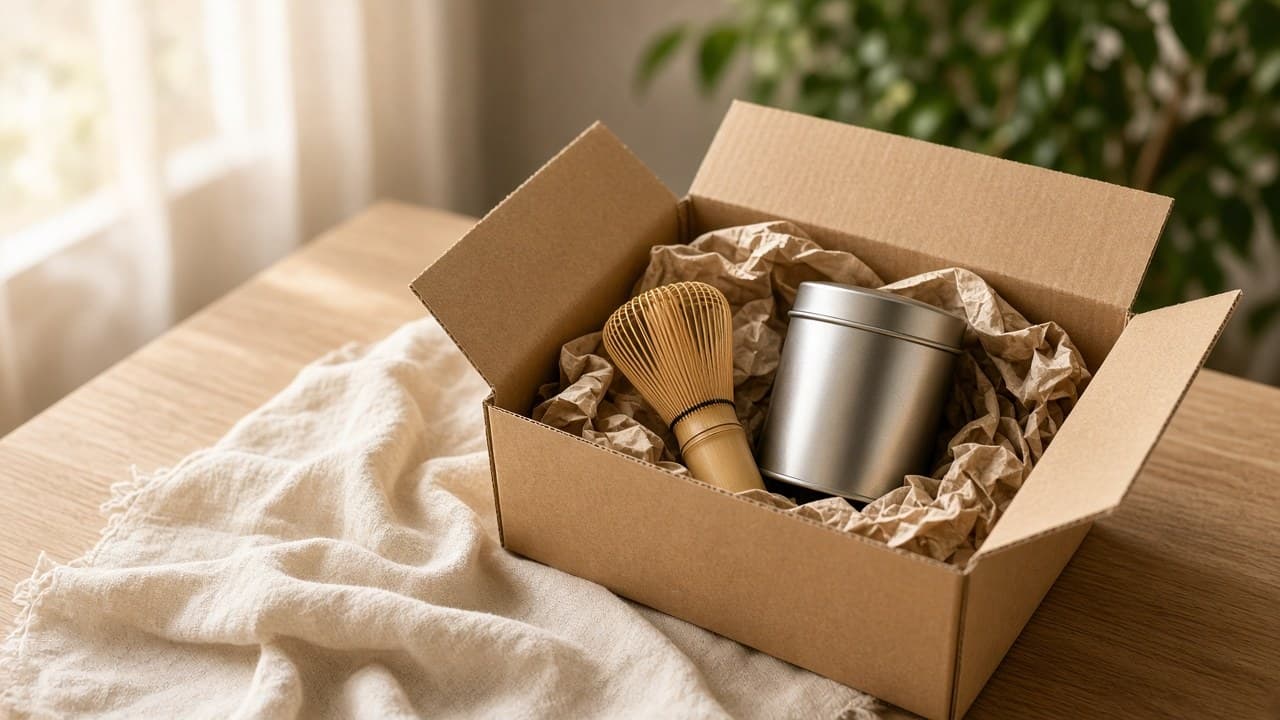
If you order matcha within the EU, you pay no customs duty and no import VAT: the VAT is already in the price. For orders directly from Japan or another non-EU country, on the other hand, import VAT, depending on the shipment customs duty, and often a fee from the parcel carrier are added, and delivery usually takes longer too. A reputable shop states seller, origin, shipping costs and return rights openly and answers questions about the batch.
Where to buy reputably: features of a good shop
When searching for good matcha, the same questions keep coming up: where do others order? Which sites are genuine? And what to do when the well-known addresses are sold out? A few features help you assess shops without needing to know names.
- Complete legal notice (Impressum): Name, address and a quick way to get in touch, such as an email address. If the company is entered in the commercial register or has a VAT ID, that information belongs there too. If name, address or contact are missing, caution is in order.
- Clear origin: The country of origin is on the product page and on the pack. A seller who sells "Japanese matcha" should be able to back that up on the label. Matcha from China exists as well; it is a product of its own and must be named as such.
- Mandatory information before purchase: The product page states the designation, ingredients, allergens, net quantity, notes on storage and use, name and address of the food business operator, the origin where it is required, and a unit price per kilogram.
- Traceable quality claims: A certificate of analysis is only an argument if it belongs to the batch with a lot number and the shop commits to it. General seals with no connection to the pack say little.
- Honest terms: "Ceremonial" is not a protected term, and the same holds for "culinary". Any seller may use both terms, so they do not replace information on origin and preparation. By "culinary", shops usually mean powder for baking, cooking and mixed drinks.
- Open prices: 30 g of Japanese matcha costs around €19 to €49 in shops. If an offer is far below that, ask about origin and storage. If it is far above, the seller should be able to explain why.
If a variety is sold out everywhere, an orderly approach helps more than haste. Many shops offer a notification on the product page as soon as the variety is available again: sign up there so that you don't have to check every day. If there is no such function, ask the seller directly by email whether and when a restock is planned. If you repeatedly read "currently not available", it is best to order from a shop with its own warehouse and visible stock. Instead of a single wished-for variety, it is worth looking at suitable alternatives: a variety from the same origin intended for the same preparation often suits your latte or your bowl just as well. The search for "exactly this matcha" from a photo or video often remains unsuccessful. It is better to look at the label: country of origin, producer and preparation note reveal more than the brand presentation.
Also with questions about "real Japanese matcha" and the best choice, there is no ranking that suits everyone. What matters is what you need it for, straight, as a latte or for baking, and whether the shop gives clear information on it. If you want to compare several varieties, start with small packs. With us there is PURE with 30 g, DAILY with 50 g and REFILL with 100 g.
Where do I buy if I have no idea? Online in a shop with an EU address that shows all the information mentioned. In shops on the spot the same check is worthwhile: read the label, look for the origin, compare best-before date and fill weight. Specialised tea shops often give advice, while in supermarkets and drugstores you usually find fewer varieties and little advice.
If you are looking for a speciality such as roasted matcha (not to be confused with hojicha, a roasted green tea), it is best to ask for it specifically in tea shops. It is a niche product, and we do not stock it.
Buying from Japan: customs, import VAT, waiting time
Do I have to pay customs duty on an order from Japan? That depends on the value of the goods, the type of goods and the rules currently in force. What is certain: a shipment from a non-EU country is declared on import, and import VAT is due. Altogether three items can arise:
- Customs duty, depending on the type and value of the goods.
- Import VAT. For tea such as matcha, the reduced rate of 7 % applies in Germany. An exemption threshold for small consignments no longer exists. Some shops calculate the tax at checkout already, otherwise the parcel carrier collects it on delivery.
- Parcel carrier fees, often as an advancement or disbursement fee that the recipient pays on delivery or by invoice.
The exact rates and value limits are set by customs and the tax authorities, and they change. The information from customs (zoll.de) or your customs office is binding. Customs duties of other countries, such as the USA, and their consequences for prices there are not covered in this article; for orders into the EU the rules described here apply.
The waiting time, too, is hard to predict. The shipment sometimes waits at customs until documents are checked, and the parcel carrier sometimes only gets in touch after days with the invoice for charges. If you are expecting a shipment from Japan, you should give your phone number and email address correctly and keep an eye on tracking.
Which parcel carrier is better cannot be said across the board. What matters is who delivers reliably in your region, whether a pickup point is nearby and how the shop attaches the customs declaration. A good shop names the shipping carrier in advance and openly points out possible charges.
Buying in the EU: shipping without customs
Within the EU single market, no customs duty is due. The VAT is already included in the price, and there is no invoice from the parcel carrier for charges. That applies to orders to Germany just as to France, the Netherlands, Spain and all other EU countries.
Our shipping costs, all with DHL:
- Shipping costs
- €4.90
- Free shipping from
- €49
- Shipping costs
- €9.90
- Free shipping from
- €89
- Shipping costs
- €14.90
- Free shipping from
- €129
We also deliver to Switzerland and Liechtenstein, but import rules apply there. Import charges and fees are borne by the recipient, and we enclose invoice and customs papers with the shipment. We do not currently deliver to Great Britain and Norway, because additional registrations are needed there. Outside Europe, for example to Canada, Australia or the USA, we do not deliver.
Several packs can be bundled in one order. That makes it easier to reach the threshold for free shipping, for example with a set or a larger pack.
Do you live outside our delivery area?
If you live in Great Britain, the USA, Canada or Australia, for example, this approach helps:
- Start locally: Local tea shops often stock matcha and can give information on origin and preparation.
- Search for suitable online shops: Specialised online shops in your country or ones that expressly confirm delivery to your country. If your country is not on the list of delivery countries, ask before ordering.
- Check the total costs: Shipping costs, possible import charges and parcel carrier fees as well as delivery time belong in the comparison, not just the pack price.
- Ask about origin and batch: A reputable shop names the country of origin and can say which batch the pack comes from.
Delivery time and packaging
How long does delivery from the EU take? Within Germany usually only a few working days, to other EU countries a little longer, because the route is longer. No customs clearance is needed, so there is no waiting time at customs. We pack in Hilden and hand the shipment to DHL; as soon as it is on its way, you receive a shipping confirmation with a tracking number by email. Around public holidays and for shipments abroad it is better to plan a buffer. If there is a problem with a delivery, first check the tracking and then contact the shop with the order number.
How is matcha packed? Matcha usually comes in tins or stand-up pouches designed to keep out light and air as far as possible. With us, DAILY and REFILL come in a stand-up pouch (doypack) with a zip closure, PURE in a tin. Matcha is sensitive: it picks up odours and loses freshness when it stands open. After opening, close the pack well and use up its contents within a few weeks, ideally.
For countries with another language, we apply a sticker in the local language when packing. That way the mandatory information is legible for you on the pack.
Returns and mandatory information
For online orders, as a consumer you generally have a statutory right of withdrawal of 14 days. Exceptions exist only in the cases regulated by law, for example for sealed goods that are not suitable for return for hygiene reasons if the seal has been removed. Details are in the shop's withdrawal policy, which you can view before buying. Report damaged or wrongly delivered goods ideally by email with a photo.
You should find this information in the shop before ordering:
- Legal notice (Impressum) with the seller's name, address and contact
- Designation, ingredients, allergens, net quantity, storage and use, name and address of the food business operator, origin where required
- Unit price per kilogram, total price including VAT, shipping costs
- Withdrawal policy, privacy notices and payment methods
On the pack itself you also find the best-before date and the lot or batch number. A sufficiently precise best-before date can replace the lot marking.
You should not have to request the information for the product page first. A shop that hides it is a bad sign.
Why an EU warehouse has advantages
Demonstrable advantages of a warehouse in the EU, from the buyer's point of view:
- No customs duty, no additional demands within the EU shipping zone: For deliveries to EU countries and to Monaco, the price at checkout is the final price. For deliveries to Switzerland and Liechtenstein, import charges can arise on receipt.
- Shorter routes: The shipment starts with us in Hilden and does not have to go through customs clearance within the EU and to Monaco.
- Contact in Europe: You settle questions about the order with a seller in Germany, not across continents.
- Returns and complaints within the EU: You don't have to send goods back overseas.
- Mandatory information under EU law: Labelling, the responsible party and the legal framework apply to the seller on the spot.
We claim no more than that: an EU warehouse says nothing about taste. For that, origin, processing and freshness count.
Frequently asked questions
Where do you source your matcha?
Our matcha comes from Japan. It is filled by a packer in the EU, and we ship it from Hilden. The country of origin is on every pack.
Where is the best place to buy matcha?
Where legal notice (Impressum), origin, mandatory information and shipping costs are openly stated. Online that is usually a shop with an EU address, on the spot a tea shop that gives information on the variety.
Does customs duty apply to matcha?
Not when buying within the EU. For imports from Japan or other third countries, import VAT is due and, depending on the value of the goods and current rules, customs duty too. Binding information is given by German customs.
I can't find good matcha in Germany. What should I do?
Order online: shops with a warehouse in Germany or the EU deliver without customs. Look at the origin, the label and a clear statement of what the powder is intended for.
Where can I get Chinese matcha?
In some tea shops and online shops, usually with "China" as the origin on the label. We sell only Japanese matcha and do not stock Chinese.